
Pricing Data
Used Round Baler Prices in 2026: John Deere, Vermeer, New Holland, and Case IH Compared
Model-by-model pricing data for the 4x5 and 5x6 round baler market. John Deere 569, Vermeer 605N, New Holland Roll-Belt 560, Case IH RB565 and the rest. Updated for Q2 2026.
Last updated: April 2026
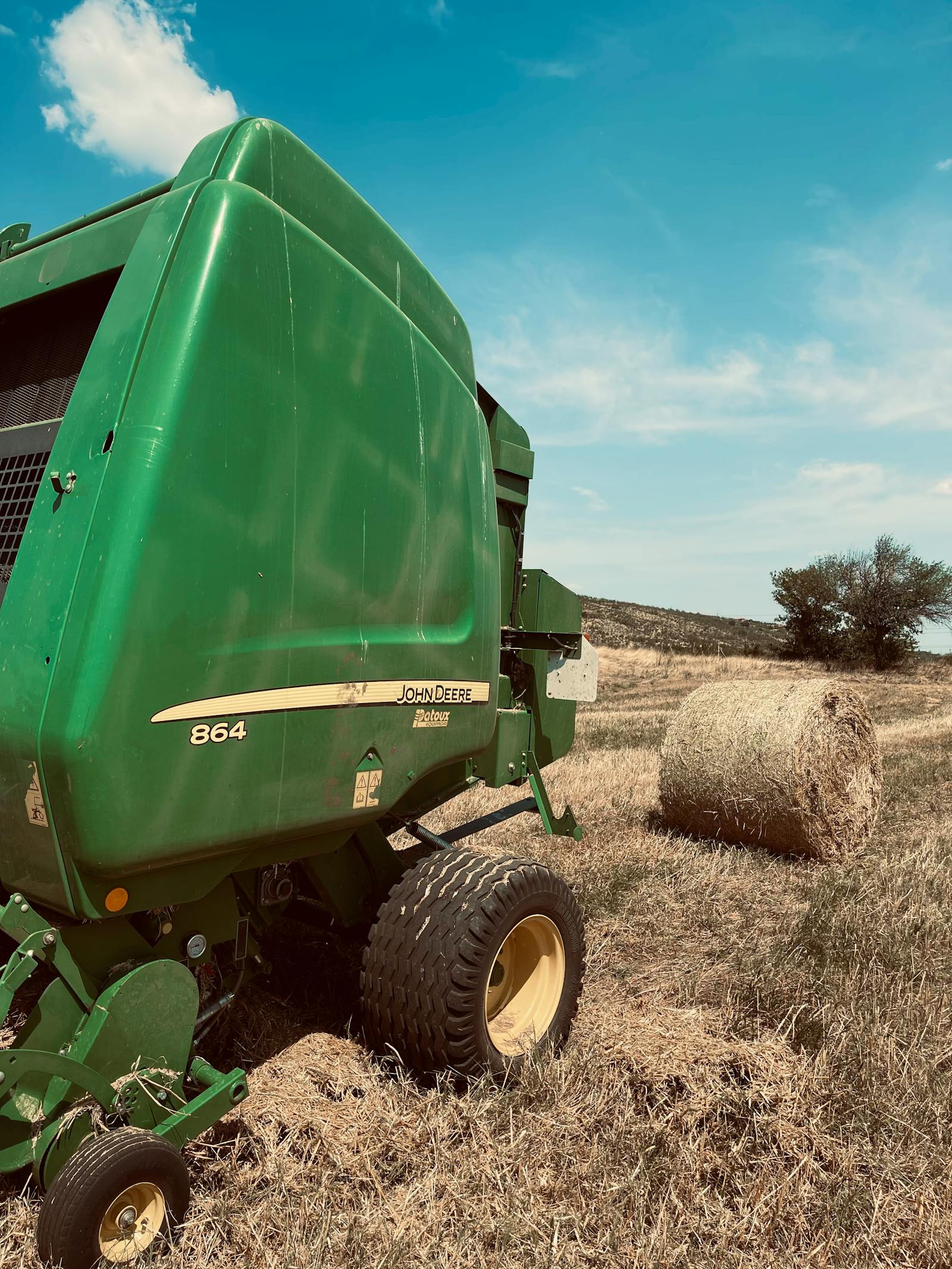
Used round baler prices in 2026 run from roughly $8,000 for a high-bale-count 1990s twine-only unit to north of $80,000 for a late-model silage-spec 5x6 baler with under 5,000 bales, based on current TractorHouse and Machinery Pete listing data. That spread captures every legitimate baler in the active hay-equipment market — the machines that small cattle operators, custom hay producers, and large commercial outfits actually buy.
Round balers are one of the most volume-sensitive purchases in farm equipment. Bale count, belt condition, pickup wear, and net-wrap function move prices more than year alone. A 2010 baler with 8,000 bales often outsells a 2018 baler with 35,000 bales at the same asking price. The tables below break pricing down by brand, model, and bale count so you can see where your target machine should sit right now.
We pulled transaction data from active and sold listings, dealer inventory, and residual-value estimates from Iron Solutions to anchor each price band. Market conditions vary by region, baler size (4x5 vs 5x6), wrap system (twine, net, or surface), and belt condition. The numbers here are realistic ballparks, not guarantees on any specific machine.
TL;DR
Used round balers trade between $8K and $80K+ depending on brand, model year, bale count, and configuration. John Deere (569, 560M, 460M) and Vermeer (605N, 604R) hold the strongest resale at roughly 62-64% retention at 15,000 bales. New Holland and Case IH trade 5-10% below the top two brands at equivalent bale counts. Net wrap adds $3K-$6K, silage-spec features add $5K-$10K, and a clean monitor with documented bale count protects 15-20% of the asking price against buyer skepticism.
How Much Does a Used Round Baler Cost in 2026?
Current prices for used round balers span $8,000 to $80,000+ across the active 4x5 and 5x6 market, per Q2 2026 listings on TractorHouse and regional dealer networks. Five main variables drive where a specific baler lands in that range: brand, model year, bale count, bale size (4x5 vs 5x6), and wrap system.
Bale count is the single biggest price lever after brand. A 2016 John Deere 569 with 8,000 bales pulls $44,000-$52,000 right now. The same model with 30,000 bales drops to $24,000-$30,000. That is a 40-50% swing on identical machines, driven entirely by the buyer's expected remaining service life.
Bale size shapes the next biggest spread. 5x6 balers carry a $4,000-$10,000 premium over equivalent 4x5 models because commercial hay operations standardize on the larger bale for transport and feed-yard handling. 4x5 balers dominate small-farm and cattle operator markets where smaller tractors and tighter fields matter more than maximum throughput.
Used Round Baler Price Range by Tier
For broader context on how round balers fit into the full hay-equipment and farm-tractor market, see our heavy equipment pricing guide covering every major machine class.
John Deere Round Baler Prices: 459, 460M, 560M, 569, and 9-Series
John Deere round balers anchor the top of the resale market in nearly every bale count and configuration band. The 569 (5x6 premium) and 560M (5x6) lead the 5-foot bale class, while the 460M (4x6) covers small-to-mid operations and the older 459 (4x5) holds steady demand among cattle producers running smaller tractors. The newer 9-series (460R/560R) introduces variable-chamber design, BalerAssist, and ISOBUS integration for premium buyers.
The single most-searched used round baler model in North America is the John Deere 569. A 2014-2016 example with 15,000-25,000 bales trades at $24,000-$34,000. A 2018-2020 569 with MegaWide Plus pickup, surface wrap, and under 12,000 bales pushes $38,000-$52,000, per current TractorHouse listings. The 569 holds value because the MegaWide Plus pickup is widely considered the most forgiving in heavy crops, and Deere's 2,100+ US dealers guarantee parts availability.
John Deere Round Baler Pricing Table
| Model | Years | Config | <15K bales | 15K–30K bales | 30K+ bales |
|---|---|---|---|---|---|
| John Deere 459 (4x5) | 2010–2014 | Twine, MegaWide pickup | $16,000–$22,000 | $12,000–$16,000 | $8,000–$12,000 |
| John Deere 460M (4x6) | 2015–2020 | Net + twine, surface wrap optional | $26,000–$36,000 | $20,000–$26,000 | $14,000–$20,000 |
| John Deere 560M (5x6) | 2015–2020 | Net + twine, MegaWide Plus | $32,000–$44,000 | $24,000–$32,000 | $17,000–$24,000 |
| John Deere 569 (5x6 Premium) | 2014–2020 | Net + twine, surface wrap, monitor | $38,000–$52,000 | $28,000–$38,000 | $20,000–$28,000 |
| John Deere 9-Series 460R/560R | 2020–2024 | Variable chamber, BalerAssist, ISOBUS | $48,000–$72,000 | $36,000–$48,000 | $26,000–$36,000 |
Prices reflect current Q2 2026 market. Sources: TractorHouse, Machinery Pete, Iron Solutions residual values. Net wrap, surface wrap, and monitor type swing individual transactions by $3,000-$8,000.
A South Dakota custom hay operation recently traded into a 2017 569 with the MegaWide Plus pickup, 19,000 bales, and surface wrap for $36,500. The same configuration sat on a Missouri dealer lot at $42,900 the previous spring. The $6,400 spread reflects the typical gap between private sale and dealer retail on a high-demand 5x6 premium baler. Both numbers anchor the mid-band on our pricing table above.
Vermeer Round Baler Prices: 504M, 604N, 604R, and 605N
Vermeer is the only major round baler maker that builds nothing else — no tractors, no combines, just balers and forage equipment. That specialization shows up in resale value. The Vermeer 605N (5x6) is the most direct competitor to the John Deere 569 and trades within $2,000-$4,000 of equivalent 569s in most markets. In Plains states (Kansas, Nebraska, South Dakota), Vermeer often pulls a small premium over Deere thanks to denser dealer footprint.
A 2014-2018 Vermeer 605N with 15,000-25,000 bales, net wrap, and the Atlas monitor typically sits at $22,000-$30,000. The same baler with under 10,000 bales jumps to $30,000-$42,000. The 605N Cornstalk Special — built for cornstalk and biomass residue baling with reinforced pickup, heavier belts, and larger main shaft — commands a $4,000-$8,000 premium and is the strongest-holding Vermeer model in the used market.
Vermeer Round Baler Pricing Table
| Model | Years | Config | <15K bales | 15K–30K bales | 30K+ bales |
|---|---|---|---|---|---|
| Vermeer 504M (4x5) | 2014–2020 | Net + twine, Atlas monitor | $22,000–$30,000 | $16,000–$22,000 | $11,000–$16,000 |
| Vermeer 604N (5x6) | 2008–2014 | Twine standard, net optional | $18,000–$26,000 | $13,000–$18,000 | $9,000–$13,000 |
| Vermeer 604R (5x6) | 2014–2018 | Net + twine, electronic tie | $26,000–$38,000 | $19,000–$26,000 | $13,000–$19,000 |
| Vermeer 605N (5x6) | 2014–2020 | Net + twine, atlas monitor, MegaTooth | $30,000–$42,000 | $22,000–$30,000 | $15,000–$22,000 |
| Vermeer 605N Cornstalk Special | 2017–2022 | Heavy-duty for residue baling | $36,000–$50,000 | $26,000–$36,000 | $18,000–$26,000 |
Prices reflect current Q2 2026 market. Sources: TractorHouse active and sold listings, Machinery Pete sold reports, Iron Solutions residual values. Cornstalk Special configurations command premiums over standard 605N in the upper bale-count brackets.
Pro Tip
When pricing a Vermeer baler, always verify the bale-count display. Vermeer monitors are robust but the older Atlas units occasionally fail and get replaced — and replacement units start at zero bales. Ask the seller for service records, dealer service printouts, or a photo of the monitor with the baler's serial number visible. A reset monitor without documentation kills 15-25% of asking price for any experienced buyer.
New Holland Round Baler Prices: BR7090, Roll-Belt 460, and Roll-Belt 560
New Holland round balers trade at meaningful discounts versus John Deere and Vermeer in the used market — typically 8-15% below Deere on equivalent bale counts. That is not a quality knock. New Holland's Roll-Belt series with the ActiveSweep pickup is engineered as well as anything in its class. The discount reflects dealer network density and the size of the buyer pool in the resale market.
The older BR7090 (5x6) is the single most-listed used baler under $20,000 right now. A 2010-2014 BR7090 with 20,000-35,000 bales typically trades at $13,000-$20,000. With CropCutter (the in-line knife system that pre-cuts the crop for tighter, denser bales), prices climb $2,000-$4,000. BR7090 buyers tend to be cattle operators and small custom hay producers prioritizing low entry cost over premium features.
The newer Roll-Belt 460 (4x6) and Roll-Belt 560 (5x6) replaced the BR series in 2013-2014 and bring the IntelliView monitor, ActiveSweep pickup, and density+ system. A 2016-2020 Roll-Belt 560 with 15,000-25,000 bales typically sits at $20,000-$28,000. Silage-spec Roll-Belt 560 units with reinforced belts and heavier rolls push $26,000-$36,000 in the same bale range.
New Holland Round Baler Pricing Table
| Model | Years | Config | <15K bales | 15K–30K bales | 30K+ bales |
|---|---|---|---|---|---|
| New Holland BR7060 (4x5) | 2010–2015 | Net + twine, RollBar pickup | $14,000–$20,000 | $10,000–$14,000 | $7,000–$10,000 |
| New Holland BR7090 (5x6) | 2009–2015 | Net + twine, CropCutter optional | $18,000–$26,000 | $13,000–$18,000 | $9,000–$13,000 |
| New Holland Roll-Belt 460 (4x6) | 2015–2020 | ActiveSweep, IntelliView monitor | $24,000–$34,000 | $18,000–$24,000 | $12,000–$18,000 |
| New Holland Roll-Belt 560 (5x6) | 2015–2021 | Net + twine, ActiveSweep pickup | $28,000–$40,000 | $20,000–$28,000 | $14,000–$20,000 |
| New Holland Roll-Belt 560 Specialty Crop | 2018–2023 | Silage-spec, density+ system | $36,000–$54,000 | $26,000–$36,000 | $18,000–$26,000 |
Prices reflect current Q2 2026 market. Sources: TractorHouse, Machinery Pete sold data, Iron Solutions. New Holland dominates the Northeast and Pennsylvania dairy markets — expect 4-7% regional premiums on Roll-Belt 560 units in those areas.
Case IH Round Baler Prices: RB454, RB464, RB554, and RB565
Case IH round balers share platform architecture with New Holland through the CNH Industrial parent company, which means similar ActiveSweep pickup design, similar density+ system, and parts cross-compatibility on many wear items. The RB565 (5x6) is the direct equivalent of the Roll-Belt 560 and trades in the same band. The RB454 (4x5), RB464 (4x6), and RB554 (5x5) round out the lineup for smaller bale operations.
A 2016-2020 RB565 with 15,000-25,000 bales and AFS Pro 700 monitor typically sits at $22,000-$30,000. Add the Premium HD silage-spec configuration and prices climb to $26,000-$36,000. The RB565 holds slightly weaker resale than the equivalent Roll-Belt 560 in most markets — the red Case IH paint pulls a smaller premium than the blue New Holland badge in the hay-equipment buyer pool. In the Midwest row-crop belt where Case IH has heritage, that gap narrows or reverses.
Case IH Round Baler Pricing Table
| Model | Years | Config | <15K bales | 15K–30K bales | 30K+ bales |
|---|---|---|---|---|---|
| Case IH RB454 (4x5) | 2014–2019 | Net + twine, ActiveSweep pickup | $22,000–$30,000 | $16,000–$22,000 | $11,000–$16,000 |
| Case IH RB464 (4x6) | 2014–2019 | Net + twine, AFS Pro 700 monitor | $24,000–$34,000 | $17,000–$24,000 | $11,000–$17,000 |
| Case IH RB554 (5x5) | 2014–2020 | Net + twine, ISOBUS optional | $26,000–$36,000 | $19,000–$26,000 | $13,000–$19,000 |
| Case IH RB565 (5x6) | 2014–2021 | Net + twine, ActiveSweep, AFS | $30,000–$42,000 | $22,000–$30,000 | $15,000–$22,000 |
| Case IH RB565 Premium HD | 2018–2023 | Silage-spec, density+ system | $36,000–$50,000 | $26,000–$36,000 | $18,000–$26,000 |
Prices reflect current Q2 2026 market. Sources: TractorHouse, Machinery Pete sold data, Iron Solutions. Case IH RB565 trades 2-5% below NH Roll-Belt 560 outside Midwest markets due to thinner dedicated dealer network for hay equipment.
Average Used Round Baler Price by Model (15K–25K Bale Band)
Which Round Baler Brand Holds Its Value Best?
John Deere leads round baler resale value retention, holding approximately 64% of original value at 15,000 bales per Iron Solutions residual data. Vermeer follows at roughly 62%. New Holland holds about 57% and Case IH 54%. Smaller brands like Krone, Massey Ferguson, and Kuhn trail at 48-52% — built well, but resale demand reflects dealer footprint more than mechanical durability.
This matches the broader pattern documented in our brand resale value comparison: the top-tier brands command premiums on every class of equipment because of dealer density, parts availability, and the size of the buyer pool — not raw mechanical superiority.
Brand Retention Comparison Table
| Brand | Value Retention @ 15K bales | Price Premium | Why |
|---|---|---|---|
| John Deere | ~64% | +5–10% | 2,100+ US dealers, MegaWide Plus pickup, strongest 5x6 demand |
| Vermeer | ~62% | +3–8% | Specialist baler maker, dominant in Plains and South, MegaTooth pickup loyalty |
| New Holland | ~57% | Baseline | CNH-owned, Roll-Belt design, strong dairy and Northeast demand |
| Case IH | ~54% | –3 to –7% | Shared CNH platform with NH, AFS monitor compatibility, Midwest row-crop heritage |
| Krone / Massey / Kuhn | ~48–52% | –8 to –15% | Quality builds but thinner US dealer footprint depresses resale demand |
Retention percentages are approximate ballparks based on Iron Solutions residual value estimates, TractorHouse sold listings, and Machinery Pete auction trends. Individual machines can swing 10-15% either direction based on configuration and regional demand.
How Bale Count Affects Used Round Baler Value
Round balers depreciate primarily on bale count, not calendar age. A typical 5x6 baler loses roughly 6-8% of value per 5,000 bales in the first 20,000 bales, per Iron Solutions fleet depreciation curves. After 30,000 bales, the curve steepens as buyers price in belt set replacement, pickup tooth replacement, and chain rebuilds.
The bale-count monitor is the single most important verification point on any used baler. Unlike tractors with hour meters tied to engine start, baler monitors only count completed bales. A baler that ran 10 hours of pickup time without making bales (clogs, breakdowns, demos) records nothing on the monitor. That makes documented bale count more reliable than tractor hours but also more vulnerable to display failures or replacements that reset the count.
How Bale Count Affects Round Baler Value
Curve represents average across 4x5, 5x6, and 5x5 round balers from major brands. Individual machines vary by belt condition, pickup wear, and maintenance history. Sources: Iron Solutions residual values, TractorHouse sold listings.
Bale Count Brackets and What Buyers Expect
Before any cash changes hands, run through our used equipment inspection guide and the hour meter guide — the same fraud-detection framework applies to baler bale-count monitors.
Round Baler Condition Grading: A, B, and C
Most dealer pricing assumes Grade B condition by default. Understanding the spread between A, B, and C grades helps you spot underpriced opportunities and overpriced traps. The grading system is informal but well-understood across the dealer and auction networks.
Grade A — Premium
- Documented service records and dealer maintenance history
- Original belts in good condition (no patches, less than 50% wear)
- Pickup teeth all present, less than 30% wear, no welds or repairs
- Functional monitor with verified bale count history
- Net wrap and twine systems both fully operational
- Stored under cover, paint condition above 80%, no rust beyond surface
Pricing: 5-15% above the mid-band number in our tables.
Grade B — Standard Used
- Belts at 50-70% wear, no major patches
- Pickup teeth 30-60% wear, a few replacements acceptable
- Monitor functional, bale count generally trustworthy
- Net wrap or twine systems both functional, minor issues acceptable
- Outdoor storage with normal field wear, paint 50-70%
Pricing: aligns with mid-band numbers in our tables above.
Grade C — Project / Working
- Belts due for replacement immediately ($2,500-$5,000 cost)
- Significant pickup wear, multiple welds or replacements
- Monitor non-functional or replaced (bale count uncertain)
- One wrap system inoperable (twine OR net, not both)
- Heavy outdoor wear, surface rust, possible structural welds
Pricing: 15-30% below mid-band numbers. Budget $3,000-$8,000 for service before first hay season.
Regional Pricing Variance: Where Round Balers Sell for More
Round baler prices vary by region more than almost any other piece of farm equipment. The Plains states (Kansas, Nebraska, South Dakota) and Texas pull premiums of 4-6% above national averages because hay production is a year-round revenue activity tied to cattle markets. The West Coast and Pacific Northwest discount 4-7% below national averages because hay acreage per buyer is lower and many operations rent equipment instead of buying.
Round Baler Price Premium by Region
Premiums measured against national average for 5x6 balers in the 15K-25K bale band. Sources: TractorHouse regional listings, Machinery Pete sold reports, 2025-2026.
Brand-specific regional patterns layer on top of these baselines. New Holland pulls an extra 4-7% in the Northeast (PA, NY, OH dairy belt). Vermeer pulls 3-5% extra in Plains states. Case IH pulls 2-4% extra in the Midwest row-crop belt. John Deere is the most consistent across all regions, with smaller variance because the dealer network is uniformly strong everywhere.
Buyers willing to ship can exploit these gaps. A West Coast buyer shopping a Kansas-listed 5x6 baler often saves $4,000-$7,000 even after factoring shipping costs. Sellers in low-demand regions often net more by listing on national platforms and arranging shipping for the buyer.
Where to Buy a Used Round Baler: Auction vs Dealer vs Private
The three main channels for used round baler purchases each carry different risk and price profiles. Knowing which channel fits your experience level and budget is the difference between a profitable purchase and an expensive lesson.
1. Dealer Retail
Dealer-sold balers come with at least an inspection, often a 30-90 day powertrain warranty, and dealer-installed reconditioning (new belts, pickup work, paint). Expect to pay 10-20% above auction comps. Best fit for first-time hay producers, buyers without strong inspection skills, or operations that need warranty-backed reliability for a known revenue season.
2. Auction (Ritchie Bros, Purple Wave, BigIron)
Auctions deliver the lowest prices — typically 15-25% below dealer retail on equivalent balers, per Ritchie Bros and Purple Wave sold-price data. The catch is total buyer responsibility for inspection, transport, and any defects discovered after the hammer drops. Best fit for experienced operators who can pre-inspect a pickup, monitor function, and belt condition independently. See our heavy equipment auction guide for the full bidding playbook.
3. Private Sale (TractorHouse, Facebook Marketplace, Craigslist)
Private sales sit between auction and dealer pricing — typically 8-15% below dealer retail. Most private sellers are willing to demonstrate the baler in the field, which is a meaningful risk reduction over auction. The trade-off is no warranty and slower transactions. Best fit for buyers who want to verify operation hands-on and are comfortable negotiating directly with the seller. For sellers, see our where to sell heavy equipment guide comparing every major platform.
Used Round Baler Inspection Checklist
Round balers have specific failure points that buyers without baler experience often miss. Run this checklist on every baler you inspect, in this order. The first three items eliminate most bad balers within ten minutes.
- Verify the bale-count monitor. Compare the displayed bale count against any service records, dealer printouts, or seller documentation. A reset or replaced monitor without paperwork is a 15-25% asking price reduction or a walk-away.
- Inspect every belt for cracks, splices, and patches. Run your hand along each belt's full length. Splices over 2 inches, multiple patches, or visible cord exposure mean a $2,500-$5,000 belt set replacement is imminent. Subtract that from the asking price.
- Check pickup teeth and the pickup reel. Count missing teeth, look for welds, and rotate the reel by hand. Multiple welded teeth signal hard use. A bent or damaged reel costs $1,500-$3,000 to replace.
- Cycle the wrap system (net and twine). Both systems should engage smoothly. Net wrap motors are a common failure point and run $800-$1,400 to replace. A baler with only twine working is worth 10-15% less than a fully functional unit.
- Open the tailgate and inspect the chamber. Look for excessive rust scaling, bent rolls, and worn chains. Replacement rolls run $400-$800 each. Chain replacement runs $300-$600 per chain depending on length.
- Check the PTO shaft, gearbox, and main drive chain. Excess play, missing safety guards, or signs of leakage all signal deferred maintenance. Gearbox rebuilds cost $1,500-$3,000.
- Run the baler if possible. The seller demonstrating the baler in actual hay is the gold standard. Listen for unusual noise from the gearbox, check that the bale chamber closes uniformly, and verify the wrap cycle completes without jamming.
For deeper coverage of equipment fraud patterns, including reset hour meters and bale counts, see our used heavy equipment scams guide.
When Is the Best Time to Buy a Used Round Baler?
Round baler prices follow strong seasonal patterns. The two best windows are November through January (post-harvest equipment liquidation) and late August through mid-September (after first cutting is complete and before fall clean-up). Auction prices in those windows drop 8-15% below peak-season pricing, per Ritchie Bros and Purple Wave seasonal data.
The worst time to buy is April through early June. Spring hay prep drives peak demand, dealer inventory thins, and auction prices firm up. A baler that traded at $24,000 in January often pulls $28,000-$30,000 by mid-May.
Section 179 tax planning also moves prices. A meaningful share of farm equipment sales happen in Q4 as operations lock in depreciation writedowns for the tax year. That boosts demand for both new and used machines into December, partially offsetting the post-harvest soft window. For more on structuring an equipment purchase for tax benefit, see our Section 179 deduction guide.
If you are financing the purchase, compare dealer programs, bank loans, and specialty ag lenders before committing. Our equipment financing guide covers current rates, down payment expectations, and the pros and cons of each funding path for hay equipment.
Tractor Pairing: What HP Class You Need
Round baler tractor requirements scale with bale size and crop conditions. A 4x5 baler runs comfortably on 50-70 HP. A 5x6 baler with no crop cutter wants 75-90 HP minimum. A 5x6 with CropCutter or pre-cut knives needs 90-110 HP for consistent throughput, especially in heavy alfalfa or wet grass.
Most cattle operators running a 4x5 baler pair it with a 60-75 HP utility tractor. Custom hay producers with a 5x6 baler typically run a 90-100 HP cab tractor for operator comfort during long days. For sizing details and pricing on the matching tractors, see our used utility tractor pricing guide and the best used tractors for small farms guide for compact and utility tractor selection.
Frequently Asked Questions About Used Round Baler Prices
How much does a used round baler cost?
A used round baler costs between $8,000 and $80,000+ depending on brand, age, bale size, and bale count. A 1990s-era twine-only baler with 15,000+ bales runs $8,000 to $14,000. A mid-2000s 4x5 baler with net wrap and 25,000-40,000 bales sits at $14,000 to $24,000. A late-model 5x6 silage-spec baler from the last five years with under 10,000 bales pushes $40,000 to $80,000. Bale count, monitor function, belt condition, and pickup wear drive the bulk of the spread within each tier.
What is a used John Deere 569 worth?
A used John Deere 569 typically trades between $24,000 and $52,000 depending on year, bale count, and options. A 2014-2016 569 with 15,000-25,000 bales and twine/net wrap usually sits at $24,000 to $34,000. A 2018-2020 569 with MegaWide Plus pickup, surface wrap, and under 12,000 bales pushes $38,000 to $52,000, based on TractorHouse and Machinery Pete listings from Q1 2026. The 569 holds value better than nearly any 5x6 baler in the used market thanks to Deere's dealer network and parts availability.
How many bales is too many on a used round baler?
Round balers in the last 20 years are generally serviceable to 60,000-80,000 bales with proper maintenance, so bale count alone does not retire the machine. Market discounting steepens above 30,000 bales as buyers price in belt replacement, pickup teeth, and chain rebuilds. Under 10,000 bales is considered low-use and earns premium pricing. The 15,000-30,000 bale band is the deepest trading range. Above 40,000 bales, expect 30-45% discounts versus low-bale comps and budget for $4,000-$8,000 in deferred service.
Which round baler brand holds its value best?
John Deere and Vermeer lead round baler resale value retention, with Deere holding roughly 64% and Vermeer 62% of original value at 15,000 bales, per Iron Solutions and Machinery Pete sold-listing data. New Holland holds about 55-58% at the same bale count, and Case IH sits at 52-56%. The gap reflects dealer network density, parts availability, and the size of the buyer pool more than mechanical quality. Vermeer specifically commands a premium in the South and Plains states where it has the densest dealer footprint.
Should I buy a used round baler at auction or from a dealer?
Auctions typically save 15-25% versus dealer retail on equivalent round balers, per Ritchie Bros and Purple Wave sold-price data, but the buyer absorbs all risk. Dealer-sold balers come with at least an inspection and often a 30-90 day powertrain warranty that auctions never include. Private sales sit between the two — typically 8-15% below dealer retail with the seller usually willing to demonstrate the baler in the field. For first-time buyers, dealer purchase is the safer path. For experienced operators who can inspect a pickup head, belt set, and monitor system independently, auction wins on price.
What is the difference between a 4x5 and 5x6 round baler price?
A 5x6 baler typically commands a $4,000-$10,000 premium over an equivalent 4x5 model from the same brand and bale count. Larger bales mean fewer bales per acre, fewer trips back to the stack, and better dry-down for silage operations — all of which appeal to commercial hay producers. 4x5 balers dominate the small-farm and cattle-operator market, while 5x6 balers are standard on 200+ acre commercial operations. Net wrap and silage-spec features add another $3,000-$8,000 to either size, depending on year and brand.
Know What Your Round Baler Is Worth
The tables, charts, and brand comparisons above give you a realistic baseline for used round baler pricing in 2026. Every baler is different — bale count, belt condition, monitor function, pickup wear, and wrap system status all move the final number. If you are selling, we provide cash offers within 24 hours based on current transaction data across TractorHouse, Machinery Pete, and dealer-network comps. No listing fees, no auction timelines, no waiting.
If you are buying, pair this pricing guide with our equipment value guide for broader pricing context and the pre-purchase inspection guide to avoid the most common buyer mistakes on hay equipment.