
Equipment Guides
Heavy Equipment Undercarriage: Inspection Guide, Replacement Costs & Tips
What track chains, rollers, idlers, and sprockets cost to replace — plus how to inspect wear before it bankrupts you.
Last updated: April 2026
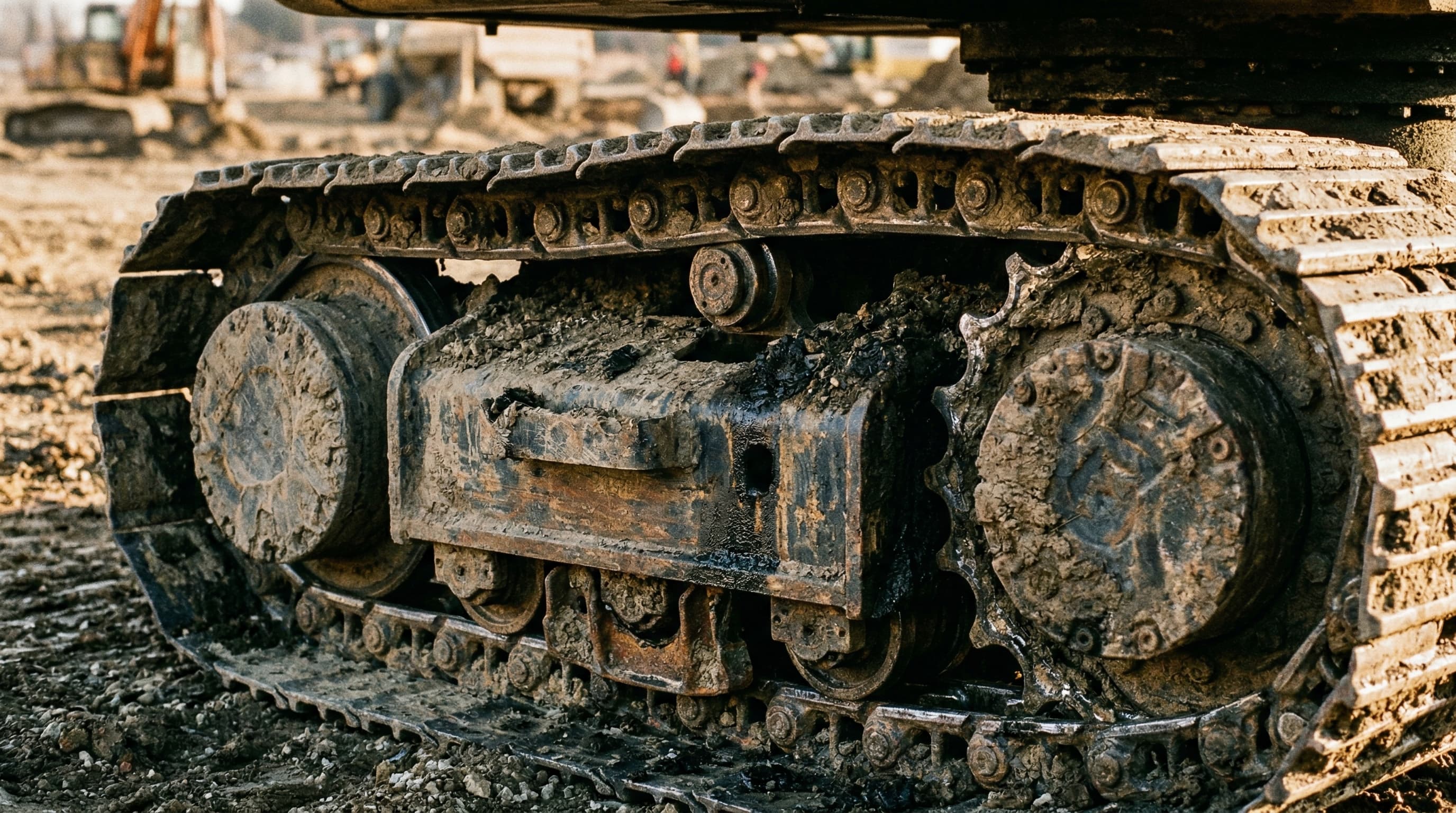
Heavy equipment undercarriage cost runs $4,500 on a mini excavator and climbs past $85,000 on a large production dozer. The undercarriage — the track chains, rollers, idlers, sprockets, and shoes that turn engine power into ground motion — is the single most expensive wear system on any tracked machine. Per Caterpillar, undercarriage represents 20-50% of a tracked machine's lifetime maintenance cost.
The good news is that undercarriage wear is measurable, predictable, and largely controllable. Operators who track wear percentages, adjust tension correctly, and replace components based on data instead of guesswork get 30-50% more life out of every chain, sprocket, and roller. Operators who don't end up replacing the same parts twice as often — and writing checks twice as large.
This guide breaks down every undercarriage component, what it does, how long it lasts, what it costs to replace, and how to inspect for wear at every service interval. Whether you run a single Bobcat T76 or a fleet of Cat 349s, the same principles apply.
TL;DR
Complete undercarriage replacement runs $4,500-$8,500 (mini ex), $7,000-$14,000 (CTL), $18,000-$35,000 (mid excavator), $22,000-$45,000 (small dozer), and $45,000-$85,000+ (large dozer). Track chains usually wear first and account for 40%+ of total cost. Inspect visually every 50 hours, measure components every 500 hours, and run a full Custom Track Service audit every 1,000 hours. Operating environment matters more than hour meter — abrasive conditions can cut life in half. Premium aftermarket parts from Berco or ITM cost 30-60% less than OEM with comparable life. Always replace components by measured wear percentage, not by schedule.
The 7 Undercarriage Components You Need to Know
An undercarriage looks like a single assembly, but it's actually seven distinct wear systems working together. Each component has its own life expectancy, failure mode, and replacement cost. Knowing what does what is the foundation of every smart maintenance decision. Per Komatsu's Undercarriage Management System, the relationship between these components determines total system life:
| Component | Function | Typical Life | Failure Sign |
|---|---|---|---|
| Track chain (links + pins + bushings) | Carries the machine and transfers drive force from sprocket to ground | 3,000-6,000 hrs | Internal pin/bushing wear, link height loss, scalloped rails |
| Track pads / shoes | Provide ground contact and traction; bolt to chain links | 2,500-5,000 hrs | Worn grouser bars, cracked or missing shoes |
| Bottom (track) rollers | Support machine weight and guide the chain along the bottom run | 4,000-7,000 hrs | Flat spots, leaking seals, audible bearing noise |
| Top (carrier) rollers | Support the upper return run of the track chain | 5,000-8,000 hrs | Flange wear, seal leaks, free play in bearing |
| Front idler | Tensions the chain and guides it around the front of the truck frame | 5,000-8,000 hrs | Tread wear, flange damage, tensioner leakage |
| Drive sprocket (segments) | Drives the chain via meshing teeth at the rear of the truck frame | 4,000-7,000 hrs (often 2x chain life) | Hooked teeth, asymmetric tooth wear, popping/jumping under load |
| Track tensioner / recoil cylinder | Maintains chain tension and absorbs shock loads | 8,000-15,000 hrs | Grease leaks, inability to hold tension, broken springs |
Track Chain (Links, Pins, Bushings)
The chain is the backbone of the undercarriage and the most expensive single component. Each link houses a pin and bushing that rotate against the sprocket as the track meshes. Internal pin and bushing wear drives most chain replacements. Caterpillar and Komatsu both publish wear charts measuring bushing outside diameter — at 100% wear, the bushings are fully consumed and the chain must be replaced or, on some Cat models, the bushings can be turned 180 degrees to expose a fresh wear surface, doubling chain life.
Track Pads (Shoes)
Pads bolt to the chain links and provide ground contact. Standard grouser bars wear from the leading edge and from impacts on rocky or paved surfaces. Triple grouser pads (the most common configuration) work for general earthmoving. Single grouser pads dig harder and last longer in dedicated dozer applications. Smooth pads are required for paved-surface work to avoid tearing up asphalt. Pad life depends almost entirely on what surface they ride on — rock chews them up, dirt and clay are kind to them.
Bottom Rollers, Top Rollers, and Idlers
Rollers carry the machine's weight and guide the chain. Bottom rollers (also called track rollers) take the brunt of the load and wear faster than top carrier rollers. Each roller is a sealed-and-lubricated unit — when the seal fails, the lube leaks out, the bearing dries, and the roller seizes. The front idler tensions the chain via a recoil cylinder and absorbs shock loads when the machine hits obstructions.
Drive Sprocket Segments
The sprocket meshes with the chain bushings and transfers drive force from the final drive to the chain. On most modern excavators and dozers, the sprocket is built as bolted-on segments rather than a single ring — making replacement much cheaper since you only swap the worn segments. Sprocket teeth wear into a hooked profile as bushings consume material. When teeth get hooked enough to start jumping under load, replacement is mandatory. A typical sprocket lasts roughly 1.5-2x the life of one chain — meaning you replace the sprocket on every other chain change.
Heavy Equipment Undercarriage Cost by Machine Class
Replacement cost scales with machine size. A mini excavator chain weighs maybe 250 pounds per side. A Cat D10 chain weighs over 6,000 pounds per side. The price tag scales accordingly. The table below shows complete undercarriage replacement cost ranges by machine class, plus typical chain and roller pricing for budgeting individual component swaps.
| Machine Class | Example Models | Chain | Roller (each) | Complete |
|---|---|---|---|---|
| Mini excavator (1-6 ton) | Cat 305, Bobcat E35, Deere 35G, Kubota KX040 | $1,400-$2,400/side | $120-$240 each | $4,500-$8,500 |
| Compact track loader (rubber track) | Bobcat T76, Cat 299D3, Deere 333G, Kubota SVL97 | Rubber track $700-$1,400/side | $180-$320 each | $7,000-$14,000 |
| Mid excavator (15-25 ton) | Cat 320, Komatsu PC210, Deere 210G, Hitachi ZX210 | $5,500-$8,500/side | $320-$520 each | $18,000-$35,000 |
| Large excavator (30-50 ton) | Cat 349, Komatsu PC360, Deere 470G | $9,000-$14,000/side | $520-$780 each | $32,000-$60,000 |
| Small/mid dozer (D5-D6 class) | Cat D5, Cat D6, Deere 750L, Komatsu D65 | $6,000-$10,000/side | $420-$680 each | $22,000-$45,000 |
| Large production dozer (D8-D10) | Cat D8T, D9T, D10T, Komatsu D155 | $14,000-$22,000/side | $780-$1,200 each | $45,000-$85,000+ |
Pricing reflects 2026 dealer quotes for premium aftermarket parts (Berco, ITM, USCO) plus typical dealer labor rates. OEM parts run 30-60% higher. Sources: dealer pricing surveys, Berco, ITM Group.
Complete Undercarriage Replacement Cost by Machine Class
For context, our heavy equipment maintenance costs guide shows that undercarriage typically accounts for the largest single line item on a tracked machine's annual maintenance budget — often more than engine, hydraulics, and drive train repairs combined. Plan for it as a recurring cost, not a one-time event.
Cost Share — 20-Ton Excavator Complete Undercarriage Job
The donut chart above shows where the money goes on a typical 20-ton excavator complete undercarriage replacement. Track chains alone are 42% of total cost, which is why chain-only replacements (when rollers and idlers still have life left) are the most common undercarriage job in the industry. Pads, sprockets, and idlers each represent smaller pieces — but the labor cost to drop the undercarriage is fixed regardless of how many components you swap.
How to Inspect Undercarriage Wear (Step by Step)
Wear inspection is a measurement exercise, not a guess. Every major OEM publishes wear charts and offers digital inspection programs. Caterpillar's Cat Inspect app and Custom Track Service program, Komatsu's UCMS, John Deere's WorkSight, and Bobcat's Machine IQ all integrate undercarriage measurements into their digital inspection workflows. Here's the field process:
- Clean the undercarriage first. Mud, packed dirt, and grease hide wear and corrupt measurements. Pressure wash both sides until you can see clean metal on every link, roller, sprocket tooth, and idler tread.
- Position the machine on level ground. Park on a flat, hard surface. Lift one track at a time using the boom or blade so the chain hangs free for accurate link height measurement.
- Measure link height with a depth gauge.Compare to the OEM's new dimension. Loss is reported as a percentage. At 100% wear, the link is fully consumed.
- Measure bushing outside diameter. Use a caliper across the bushing where it engages the sprocket. Bushing wear drives chain replacement timing more than any other measurement.
- Inspect sprocket tooth profile. Compare to a wear template. Hooked teeth, asymmetric wear, or chipped tips signal replacement is due.
- Check roller flanges and idler tread.Look for flat spots, flange damage, oil leaks, and play in bearings. Spin each roller by hand if you can — anything that doesn't spin freely is failing.
- Verify track tension. Each OEM publishes a slack measurement spec. Too tight and you accelerate bushing, sprocket, and roller wear. Too loose and the chain can derail. Check at every 250-hour service.
- Document everything. Record measurements digitally so you can plot wear curves over time. Trend data is more valuable than any single reading.
Most Cat, Komatsu, John Deere, and Bobcat dealers will perform a full undercarriage measurement audit for $150-$300 and return a digital report with percentage wear on every component plus a remaining-life projection. For a fleet owner, this is one of the highest-value services available — pair it with fluid analysis for a complete machine condition snapshot.
Recommended Undercarriage Inspection Intervals
Pro Tip
Photograph the same reference points (a sprocket tooth, a representative roller, the idler tread) every 500 hours from the same angle. Visual side-by-side comparison reveals wear acceleration that's easy to miss in raw measurements. Save the photos with the hour meter reading in the filename. When it comes time to sell the machine, a documented undercarriage history adds real money to the offer.
Wear Percentages: When to Act
OEM wear charts express component condition as a percentage from 0% (new) to 100% (fully consumed). The action thresholds are similar across Cat, Komatsu, and Deere:
- 0-50% wear — Normal. Continue monitoring at standard intervals. No action needed.
- 50-80% wear — Plan ahead. Order replacement parts and begin scheduling downtime. This is the window where coordinating multiple component replacements together saves the most labor.
- 80-100% wear — Replace soon. Above 80%, wear acceleration increases sharply. Components that fail at 100% can take adjacent parts with them — a worn sprocket damages a new chain, a worn chain destroys a fresh sprocket.
- 100%+ wear — Replace immediately or risk catastrophic failure and collateral damage. A failed bushing can shred an entire chain section and damage rollers and the sprocket in a single shift.
Wear Progression by Operating Environment
The chart above illustrates why hour meter alone is a terrible predictor of undercarriage life. The same machine running on packed clay can hit 7,000 hours before reaching 100% wear, while the same model running in abrasive sand or sharp rock can be done at 2,500 hours. Per Caterpillar's mining undercarriage data, abrasive environments can multiply wear rates by 3-4x compared to ideal conditions. Always inspect by measurement, never by hour count alone.
Selling a machine with worn undercarriage?
We buy machines in any undercarriage condition. Get a no-haggle cash offer with free pickup nationwide.
OEM vs Aftermarket Undercarriage Parts
The OEM-versus-aftermarket question drives more undercarriage cost decisions than any other variable. Cat, Komatsu, John Deere, and Bobcat all sell branded undercarriage parts at premium pricing. Independent aftermarket suppliers — Berco, ITM, USCO, ITR, DRP — sell parts that fit the same machines for 30-60% less. Many of those aftermarket parts come out of the same Italian and Korean foundries that supply the OEMs themselves.
Quality varies more in the aftermarket category. Premium suppliers like Berco and ITM match OEM hardness specifications and typically deliver 90-100% of OEM life. Budget aftermarket can wear 25-40% faster, which often eliminates the upfront savings on a cost-per-hour basis. The pattern most experienced fleet managers follow:
- High-hour production fleets — Premium aftermarket (Berco, ITM) usually delivers the lowest cost per hour. Track hours and cost meticulously to verify.
- Resale machines — OEM parts preserve more resale value. Buyers (and auction inspectors) often pay a premium for documented OEM undercarriage history.
- Warranty-period machines — Stick with OEM to preserve warranty coverage, especially on recently purchased used machines still under financed warranty terms.
- Light-use machines— Budget aftermarket is fine when you'll never approach the part's rated life anyway.
For brand-specific undercarriage cost behavior across the major manufacturers, our Cat vs Komatsu vs John Deere comparison breaks down resale value impact and OEM parts pricing across the big three.
Compact Track Loader Undercarriage: Why It's Different
CTLs are the most undercarriage-cost-sensitive machines on a typical job site. Bobcat T-series, Cat 299D, John Deere 333G, Kubota SVL, and Takeuchi TL-series all use rubber tracks, smaller steel rollers, and higher operating speeds than excavators or dozers — and they pay for it in undercarriage life. A typical CTL undercarriage lasts 1,500-2,500 hours versus 4,000-7,000 hours on a steel-track excavator.
Rubber tracks are the biggest consumable. A pair of rubber tracks for a Bobcat T76 or Cat 299D3 runs $1,400-$2,800. Quality varies wildly by brand — Camso (now Continental), Bridgestone, McLaren, and OEM rubber typically deliver the best life per dollar. Cheap imports often crack within 500-800 hours.
Operator habits drive CTL undercarriage life more than any other factor:
- Avoid sharp counter-rotation on pavement. Pivoting in place on hard surfaces tears rubber tracks and accelerates roller wear. Three-point turns instead of pivots can double track life.
- Don't side-hill operate when avoidable. Side loading puts asymmetric stress on the rollers and stretches the track on one side.
- Keep tracks tensioned correctly. CTL tracks are more sensitive to over-tensioning than steel chains. Check OEM spec — usually 1-2 inches of slack at the midpoint.
- Clean debris out of the track frame daily. Rocks and sticks lodged between the track and rollers act like grinders.
- Watch curb and rebar exposure. A single drag across exposed rebar can put a hole through a $1,400 rubber track.
For a complete view of CTL ownership economics, see our used CTL pricing guide and the skid steer vs CTL comparison — undercarriage cost is the single biggest economic difference between the two formats.
Real-World Cost Example: Cat 320 Undercarriage Replacement
Consider a Cat 320 mid-size excavator with 5,800 hours that ran predominantly on packed clay sites. Internal pin and bushing measurement comes back at 92% wear, sprocket teeth show hooked profile at roughly 75% wear, bottom rollers measure 60% wear with no leaks, and idlers are at 55% wear. Here's the math for a complete-versus-partial decision:
| Scope | Parts | Labor | Total |
|---|---|---|---|
| Chains + sprockets only | $13,500 | $2,800 | $16,300 |
| Chains + sprockets + rollers | $18,200 | $3,400 | $21,600 |
| Complete (everything) | $22,000 | $3,800 | $25,800 |
The right decision in this scenario is usually the middle option. Replacing chains, sprockets, and rollers together adds $5,300 over chains-only but saves a future labor charge of roughly $2,800-$3,400 and 1-2 days of downtime when those rollers reach 80% wear in another 1,200-1,500 hours. The complete replacement only makes sense if the idlers also need attention or if the machine is heading into another high-wear assignment.
Match this logic against current used excavator pricing before pulling the trigger. If the machine is worth $80,000 and the undercarriage job is $25,800, that's 32% of value going into one repair. It still makes sense if the rest of the machine is sound, but it's a reasonable trigger to evaluate whether trading or selling is the better play. Our full equipment pricing guide walks through the math.
How to Extend Undercarriage Life (and Reduce Cost)
Operators who get 30-50% more life out of their undercarriage do five things consistently:
- Maintain correct track tension. Over-tensioned chains accelerate bushing, sprocket, and roller wear faster than any other operator-controllable factor. Cat publishes track sag measurements for every model — measure at every 250-hour service. Komatsu, Deere, and Bobcat do the same.
- Pick the right pad width.Wider pads reduce ground pressure but accelerate wear in turning. Narrower pads dig harder. Match pad width to the application — wide pads for soft ground machines that don't turn much, narrower pads for hard ground machines that maneuver.
- Operate in straight lines when possible. Every turn loads one side of the undercarriage harder than the other. Plan the work pattern to minimize counter-rotation, especially on hard surfaces.
- Clean the undercarriage daily in muddy conditions. Packed mud holds abrasives against components and traps debris in the track frame. A 10-minute pressure wash at end of shift can add hundreds of hours to chain life.
- Turn bushings on Cat SystemOne chains.Cat's SystemOne and HeavyDuty SystemOne chains allow bushings to be rotated 180 degrees to expose a fresh wear surface. A bushing turn at roughly 50% wear can effectively double chain life. Most Cat dealers handle this as a routine service.
These practices stack. A fleet that does all five typically sees 40-60% lower per-hour undercarriage cost than a fleet that does none of them — turning a $25,000 replacement that comes due every 4,000 hours into one that comes due every 6,000-7,000 hours.
Frequently Asked Questions About Heavy Equipment Undercarriage
How much does a heavy equipment undercarriage cost to replace?
A complete undercarriage replacement runs $4,500-$8,500 on a mini excavator, $7,000-$14,000 on a compact track loader, $18,000-$35,000 on a mid-size excavator, and $35,000-$85,000+ on a large dozer or production excavator. The total includes track chains, rollers, idlers, sprockets, and labor. Component-only replacements (just chains, just rollers) cost a fraction of the full job. Caterpillar, Komatsu, John Deere, and Bobcat OEM parts run 30-60% higher than aftermarket equivalents from suppliers like ITM, Berco, or USCO.
What is the average lifespan of an excavator undercarriage?
A well-maintained excavator undercarriage typically lasts 4,000-7,000 hours before needing major component replacement, though abrasive conditions can cut that to 2,500-3,500 hours. Track chains usually wear first, followed by sprockets and rollers. Bobcat, Cat, and Deere all publish wear charts showing acceptable percentages — at 100% internal pin and bushing wear, a chain is fully consumed and replacement becomes mandatory. Operating environment matters more than hour meter — a machine in dry sand wears 2-3x faster than one on packed clay.
How do I check undercarriage wear percentage?
Measure each component against the manufacturer's wear chart using a depth gauge or specialized undercarriage measuring tool. Track the link height, bushing outside diameter, sprocket tooth profile, roller flange wear, and idler tread depth. Caterpillar offers Cat Inspect and Custom Track Service (CTS) inspections with digital reports. Most dealers will perform a full undercarriage measurement for $150-$300, which pays for itself by catching wear before catastrophic failure. Aim to inspect at every 500-hour service interval.
Should I replace just the track chains or the whole undercarriage?
Replace components based on measured wear, not on a whole-system schedule. Track chains usually hit 100% wear before rollers and idlers reach 50%, so chain-only replacement is common. However, if rollers are at 70%+ wear when you replace the chain, it's cheaper to do them together than to schedule two separate jobs. The labor to drop the undercarriage is the same whether you replace one component or all of them. As a rule of thumb, when any component hits 80% wear, plan to replace it during the next chain swap.
What's the difference between OEM and aftermarket undercarriage parts?
OEM undercarriage parts (Cat, Komatsu, John Deere, Bobcat factory parts) are manufactured to original tolerances and carry full warranty coverage. Aftermarket parts from Berco, ITM, USCO, ITR, and DRP are produced by the same Italian and Korean foundries that supply many OEMs and typically run 30-60% cheaper. Quality varies — premium aftermarket like Berco or ITM matches OEM hardness and life. Budget aftermarket can wear 25-40% faster. For high-hour production fleets, premium aftermarket usually delivers the best cost per hour. For resale machines, OEM parts preserve more value.
Why does undercarriage wear so fast on my compact track loader?
Compact track loaders (Bobcat T-series, Cat 299D, Deere 333G, Kubota SVL) wear undercarriage faster than excavators because the rubber tracks, smaller rollers, and higher operating speeds work against component life. CTL undercarriage typically lasts 1,500-2,500 hours versus 4,000-7,000 on a steel-track excavator. Operator habits matter most: sharp counter-rotation on pavement, side-hill operation, and running at full tilt across abrasive surfaces all accelerate wear. Rotating the machine instead of pivoting in place can double rubber track life.
Ready to Buy or Sell Tracked Equipment?
Undercarriage condition is one of the largest single factors in tracked equipment value. A machine with documented 30% wear sells for thousands more than the same machine with undocumented wear at the same hour reading. Whether you're shopping for your next excavator or dozer or moving on from a machine that needs work, undercarriage data drives the price.
Browse current excavator, bulldozer, and compact track loader market values, or get a firm cash offer on your machine in 24 hours.