
Industry Trends
Electric Heavy Equipment in 2026: Battery Excavators, Loaders, and Tractors
What is actually for sale, what it costs, how long it runs on a charge, and whether the math works for fleet buyers in 2026.
Last updated: April 2026
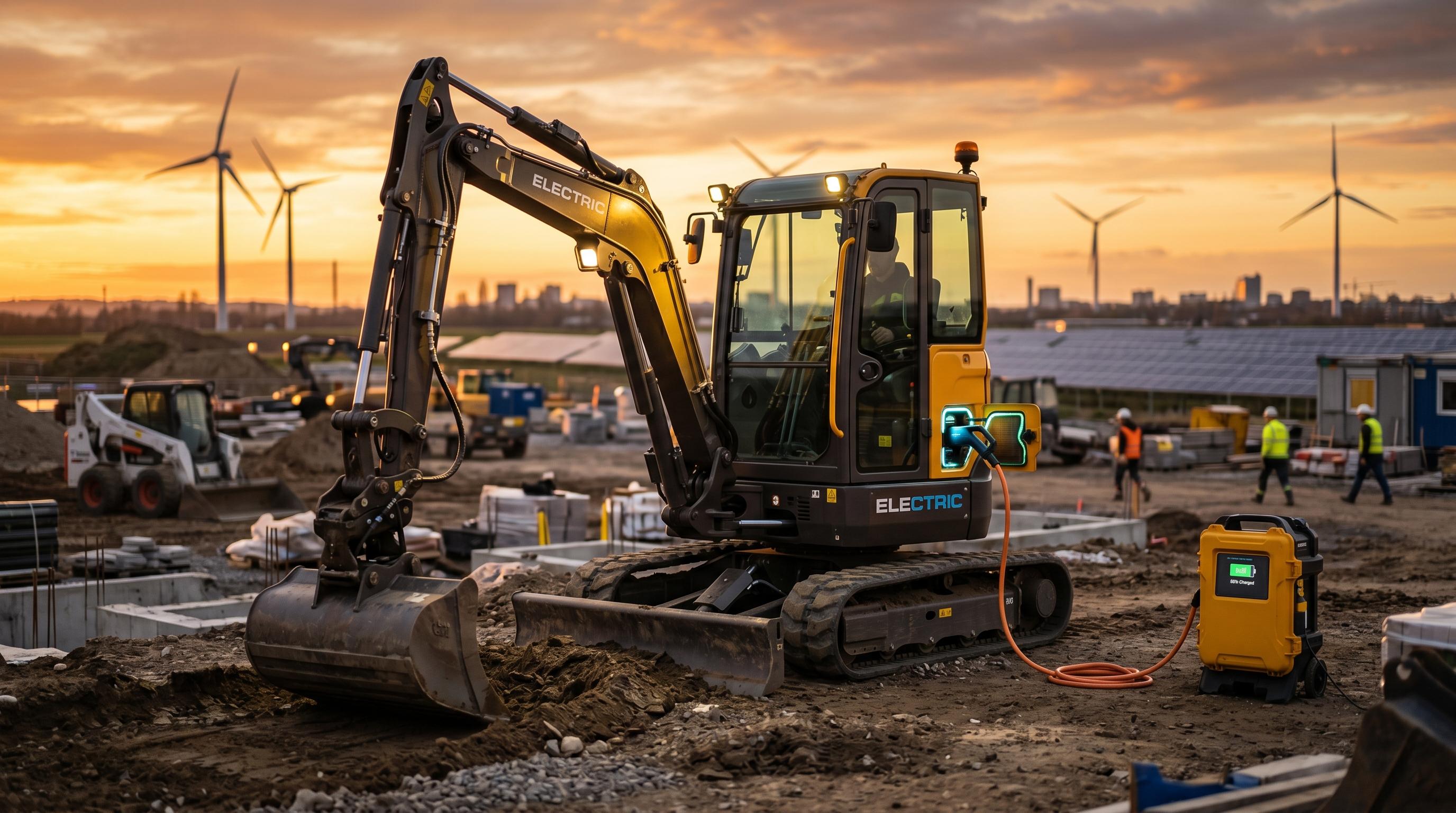
Electric heavy equipment is no longer a 2030 promise. In 2026, every major manufacturer — Volvo CE, Caterpillar, John Deere, Case IH, Kubota, JCB, Bobcat, Komatsu, and Develon — is shipping at least one battery-powered machine in the compact class, and a real catalog is forming above it. The question for fleet buyers is no longer "does it exist?" but "does the math work for my duty cycle?"
The short answer for compact excavators, loaders, skid steers, and small utility tractors is increasingly yes — especially for indoor demolition, urban construction, vineyards, dairy operations, and any contractor with public-sector contracts in California, New York, or other emissions-restricted markets. For 50-ton excavators and 200 HP row-crop tractors, the answer is still mostly "not yet at production scale," though Volvo CE, Caterpillar, and John Deere all have prototypes running with utility customers.
This guide walks through the real machines you can buy or lease in 2026, what they cost against diesel equivalents, how long they actually run on a charge, what charging infrastructure is involved, and where the total-cost-of-ownership crossover sits. The data comes from OEM specifications, dealer pricing pulled in Q1 and Q2 2026, the EPA Tier 4 program, and California Air Resources Board (CARB) Advanced Clean Fleets compliance documentation.
TL;DR
Electric heavy equipment is real and shipping in 2026, mostly in the compact class (under 8 tons). Expect a 35-70% purchase premium over diesel, recovered partially by federal IRA Section 45W credits and CARB HVIP/CORE vouchers. Runtime is 4-8 hours per charge for compact excavators and loaders, 8-10+ hours for electric tractors and the John Deere 310X-E backhoe. Total cost of ownership crosses below diesel around year 3-4 for high-utilization machines. Heavy iron (50-ton excavators, 200+ HP tractors) is still mostly pilot-program territory.
What Counts as Electric Heavy Equipment in 2026?
The category splits into three powertrain types, and they are not interchangeable from a buyer's perspective:
- Battery-electric (BEV). Lithium-iron-phosphate (LFP) or NMC pack drives a permanent-magnet motor. Plugs in to charge. This is the dominant segment in 2026 — Volvo, Cat, JCB, Bobcat, John Deere, Case IH, Kubota, and Solectrac all sell BEV machines.
- Plug-in hybrid (PHEV). Smaller battery plus a diesel range extender. Useful for high-duty applications where pure BEV runtime falls short. Less common in 2026 catalogs but appearing on heavier wheel loaders and graders.
- Hydrogen fuel cell. Hydrogen feeds a fuel cell that powers an electric drivetrain. JCB has shipped hydrogen-combustion units; Komatsu and Hyundai CE have fuel-cell prototypes. Production is years out for most fleets.
When the industry says "electric heavy equipment" in 2026, it almost always means battery-electric. Fuel cell and PHEV are still rounding errors in unit volume. For the rest of this guide, we focus on BEV.
What Electric Heavy Equipment Is Actually For Sale Right Now?
The deepest production catalog in 2026 sits in the compact class — sub-5-ton excavators, sub-8-ton wheel loaders, electric skid steers and compact track loaders, electric backhoes, and small utility tractors. Above that line, most offerings are pilot-program units sold or leased to specific customers (utilities, public works, large GCs) rather than catalog stock available through any dealer.
The tables below cover the real production and near-production machines as of Q2 2026. Pricing is dealer-quoted retail in the United States; runtime is mixed-duty and varies with operator behavior, ambient temperature, and attachment load.
Battery-Electric Excavators
The compact electric excavator segment is the most mature. Volvo CE was first to volume with the ECR25 Electric, and the entire industry has now followed. Every machine in this table is either currently for sale at dealers or in a public commercial pilot.
| Model | Weight | Battery | Runtime | Charging | US Price |
|---|---|---|---|---|---|
| Volvo ECR25 Electric | 2.7 t | 20 kWh / 38 kWh option | 4–8 hrs | Level 2 (6 hrs) / DC fast (1 hr) | $98K–$110K |
| Caterpillar 301.9 Electric | 1.9 t | 32 kWh | 4–6 hrs | Level 2 (5 hrs) | $80K–$95K |
| JCB 19C-1E | 1.9 t | 20 kWh / 24 kWh | 4–5 hrs | Level 2 (8 hrs) / boost (2 hrs) | $78K–$92K |
| Develon DX17Z-7E | 1.7 t | 32 kWh | 5–7 hrs | Level 2 (5 hrs) | $72K–$85K |
| Bobcat E10e | 1.1 t | 17 kWh | 4–6 hrs | Level 2 (8 hrs) | $65K–$78K |
| Komatsu PC30E (pilot) | 3.0 t | 40 kWh | 5–7 hrs | Level 2 (7 hrs) / DC fast | Pilot only |
Sources: Volvo CE, Caterpillar, JCB, Develon, Bobcat, and Komatsu OEM specifications, 2026 dealer quotes. Pilot-program machines are not generally available outside specific customer programs.
For broader pricing context across both diesel and electric compact machines, our used mini excavator prices guide covers what the diesel market trades at right now — the relevant comparison point when you are running the math on going electric.
Diesel vs Battery-Electric Purchase Price (2026 Compact Class)
Battery-Electric Loaders, Skid Steers, and Telehandlers
The electric loader segment includes compact wheel loaders, skid steers, compact track loaders, and telehandlers. Caterpillar leads in compact wheel loaders with the 906 and 908 Electric, both based on production diesel platforms with the engine and tank swapped for an LFP pack and electric drivetrain. Bobcat's T7X (compact track loader) and S7X (skid steer) replaced not just the engine but every hydraulic actuator with electric servos, eliminating hydraulic fluid entirely on the T7X.
| Model | Type | Weight | Battery | Runtime | US Price |
|---|---|---|---|---|---|
| Caterpillar 906 Electric | Compact wheel loader | 5.5 t | 146 kWh | 5–7 hrs | $185K–$220K |
| Caterpillar 908 Electric | Compact wheel loader | 8.0 t | 192 kWh | 5–7 hrs | $235K–$275K |
| Volvo L25 Electric | Compact wheel loader | 5.3 t | 40 kWh / 80 kWh | 4–8 hrs | $165K–$210K |
| Bobcat T7X | Electric compact track loader | 4.8 t | 62 kWh | 4 hrs heavy / 6 hrs avg | $155K–$185K |
| Bobcat S7X | Electric skid steer | 3.9 t | 62 kWh | 4–6 hrs | $140K–$170K |
| JCB 525-60E | Electric telehandler | 4.9 t | 24 kWh | 5 hrs avg | $140K–$165K |
Sources: Caterpillar, Volvo CE, Bobcat, JCB OEM specifications and 2026 US dealer pricing. Battery sizes shown are nominal; usable capacity is typically 85-90% of nominal.
The Bobcat T7X is worth special attention. It runs entirely on electric servos rather than hydraulics — meaning no hydraulic pump, no hydraulic fluid, no hydraulic leaks, and no hydraulic noise. For indoor demolition and food-and-beverage facility work, that is the single biggest operational change electric equipment has delivered so far. For the diesel comparison case, see our used skid steer pricing breakdown.
Battery-Electric Backhoes
John Deere's 310X-E is the most widely deployed electric backhoe in North America. Built in partnership with Kreisel Electric on a 320kWh LFP pack, it targets utility crews — exactly the customer who runs a backhoe 6 to 8 hours a day, parks it overnight at the yard, and benefits most from removing diesel from the duty cycle. Pacific Gas & Electric, Xcel Energy, and Southern California Edison all run pilot fleets of the 310X-E in 2025-2026.
JCB takes a different approach with its 3CX hydrogen-combustion backhoe — burning hydrogen in a modified diesel engine rather than running a fuel cell. Both approaches are real; the deciding factor is whether your fleet has access to hydrogen fueling (rare in the US outside California ports) versus electric charging infrastructure (common everywhere).
Battery-Electric Tractors (Ag and Utility)
Electric tractor production is led by Monarch Tractor (the MK-V, in commercial production since 2023), Solectrac (now owned by Ideanomics, the e25, e70N, and e70U), and Kubota with the LXe-261 prototype in pilot leases. Case IH and John Deere have shown electric tractor concepts but neither has set a production date for full battery-electric row-crop machines.
| Model | Horsepower | Battery | Runtime | US Price | Notes |
|---|---|---|---|---|---|
| Monarch MK-V | 40 HP cont. / 70 HP peak | 70 kWh | 10 hrs typical chore | $78K–$95K | Driver-optional autonomy, commercial production |
| Solectrac e70N (narrow) | 70 HP | 55 kWh | 5–8 hrs | $72K–$85K | Vineyard/orchard, AC drivetrain |
| Solectrac e25 | 25 HP | 27 kWh | 4–6 hrs | $32K–$42K | Small property/hobby/small dairy |
| Kubota LXe-261 (pilot) | 21 HP equiv. | 27 kWh | 4 hrs | Pilot only | Compact utility, lease pilots |
| Case IH Farmall 75C Electric (concept) | 75 HP equiv. | TBD | TBD | Not yet for sale | Concept/prototype, no production date |
| John Deere 8R EV (concept) | Row-crop equivalent | TBD | TBD | Not yet for sale | Battery row-crop concept, autonomous focus |
Sources: Monarch Tractor, Solectrac/Ideanomics, Kubota, Case IH, John Deere 2025-2026 product communications. Concept and pilot machines are not generally available for retail purchase.
For the diesel side of the same horsepower range, see our used utility tractor pricing guide covering 40-100 HP machines, and our Kubota vs John Deere vs Mahindra compact tractor comparison for the sub-40 HP class where most electric tractor competition currently lives.
How Long Do Battery-Electric Machines Actually Run?
Runtime is the question every diesel operator asks first, and the honest answer in 2026 is "long enough for most duty cycles, but not all of them." The chart below pulls OEM mixed-duty runtime claims for the major production electric machines.
Single-Charge Runtime by Model (Mixed Duty)
Three patterns are worth flagging:
- Cold weather drops runtime 15-25%. Below 32°F, lithium chemistry slows. Battery-warming systems help but draw energy themselves. A summertime 6-hour Volvo ECR25 Electric becomes a 4.5-hour machine in January.
- Heavy continuous load drops runtime 10-15%. Continuous trenching draws more energy than landscaping or grading. Spec sheets typically reflect mixed light-to-medium duty, not 100% engine-load equivalents.
- Lunch-break charging changes the math.A 30-minute DC fast charge can add 3-4 hours of runtime on supported machines. Most contractors who go electric stop thinking in terms of "single charge runtime" and start thinking in terms of "daily availability" — which is functionally unlimited if the charger is on site.
Pro Tip
When evaluating an electric machine, ask the dealer for OEM duty-cycle data, not just "up to" runtime claims. Volvo CE and Caterpillar publish energy consumption in kWh per hour for trenching, grading, and material handling separately. Multiply your daily duty mix by those values, divide into usable battery capacity (85-90% of nominal), and you get realistic runtime — usually 70-85% of the marketing number.
Charging Infrastructure: What You Actually Need
Compact battery-electric equipment charges on the same hardware as electric pickup trucks. A standard Level 2 charger (240V, 32-80 amp) refills most compact excavators, skid steers, and small loaders in 4-8 hours overnight. Bigger machines with 100kWh-plus packs benefit from DC fast charging (60-150kW), which can refill 70-80% of capacity during a lunch break.
Three charging patterns dominate real-world fleet deployments:
- Yard-based overnight charging. Machine returns to the yard nightly, plugs in to Level 2, deploys with full battery the next morning. Cheapest infrastructure ($3,000-$8,000 per charger installed). Best for short-radius urban contractors and utilities.
- On-site DC fast charging. Contractor brings a 60-150kW DC fast charger to the job site, often shared across multiple machines. Installation cost $25,000-$80,000 plus utility service work. Common on long-duration commercial projects.
- Mobile battery / generator trailer.Companies like Moxion Power, Volvo CE's PU500 portable energy unit, and Caterpillar Energy Solutions offer trailered battery systems that charge equipment overnight on remote sites with no grid hookup. Rents for $3,500-$8,500 per month.
The single most common mistake fleets make is sizing charging for "average" rather than "worst case." If three machines need to be ready at 7am, the charger has to refill them simultaneously overnight, not sequentially. Plan for peak load, then add 20% headroom.
Total Cost of Ownership: Where Does Electric Beat Diesel?
Battery-electric heavy equipment carries a 35-70% purchase premium over diesel in 2026 — but it pays back through energy and maintenance savings. The crossover depends entirely on utilization. A machine that runs 1,500 hours per year crosses below diesel TCO around year 2-3. A 500-hour-per-year machine may never cross. Below is a worked example for a Volvo ECR25 (diesel) versus ECR25 Electric over a 10-year horizon at 1,000 hours/year.
| Cost Component | Diesel | Electric | Notes |
|---|---|---|---|
| Purchase price | $58,000 | $104,000 | Volvo ECR25 vs ECR25 Electric, 2026 dealer pricing |
| Federal/state incentive (avg) | $0 | −$25,000 | IRA 45W + CARB HVIP/CORE typical eligible amount |
| Net acquisition cost | $58,000 | $79,000 | After typical incentives |
| Energy cost / hour | $8.50 | $2.20 | Diesel @ $4.20/gal × 2 gph; electric @ $0.13/kWh × 17kWh/hr |
| DEF / DPF service / yr | $650 | $0 | Tier 4 Final fluid + filter cycles |
| Engine oil / filter / yr | $420 | $0 | No combustion = no engine oil service |
| Major service @ 5K hrs | $5,500 | $2,200 | Top-end inspection vs battery health check |
| 10-year operating cost (1,000 hrs/yr) | $143,000 | $58,000 | Energy + scheduled maintenance only |
| Total 10-year TCO | $201,000 | $137,000 | Net-of-incentive purchase + 10-yr operating |
Worked example, Volvo ECR25 vs ECR25 Electric, 1,000 hrs/yr, US, 2026 pricing. Energy, maintenance, and incentive figures based on Volvo CE published data, IRA Section 45W qualification, CARB HVIP/CORE 2025 voucher amounts, and EIA commercial electricity averages.
10-Year Cumulative TCO: Diesel vs Battery-Electric
Three things drive that crossover, and all three are sensitive to your fleet's specifics:
- Energy cost spread. Diesel at $4.20/gal vs electricity at $0.13/kWh. The bigger the spread, the faster electric pays back. Coastal utilities with $0.25/kWh power and cheap regional diesel see slower crossover; Midwest fleets with $0.10/kWh power and expensive low-sulfur diesel see faster crossover.
- Annual hours. Energy and maintenance savings scale with utilization. A 2,000-hour-per-year machine pays back roughly twice as fast as a 1,000-hour-per-year machine on the same powertrain spread.
- Incentive capture. The IRS Section 45W Commercial Clean Vehicle Credit can be worth up to $40,000 per qualifying machine. CARB HVIP and CORE vouchers stack on top in California for up to $250,000 per unit on the largest classes. Capturing both can take $50,000-$80,000 off acquisition cost on a single compact loader.
For a comprehensive look at how to model these costs across any equipment class, our cost-per-hour calculator and TCO framework walks through the full math, and our heavy equipment maintenance cost guide covers what diesel machines actually cost to keep running — the baseline electric equipment is competing against.
Emissions Compliance: Why Electric Is Showing Up Now
Two regulatory threads are pushing electric heavy equipment from optional to required in specific markets. The first is the EPA Tier 4 Final program, which by 2026 has effectively maxed out diesel emissions reductions through DEF, DPF, EGR, and SCR. Adding more aftertreatment to diesel engines now produces diminishing returns — and the cost of compliance at every regen cycle is real.
The second thread is the California Air Resources Board (CARB) Advanced Clean Fleets rule, which mandates that high-priority and federal fleets purchase only zero-emission vehicles starting January 2024 and phases in similar requirements for state and local fleets through 2035. CARB's parallel CORE (Clean Off-Road Equipment) voucher program directly subsidizes battery-electric construction equipment to bridge the cost gap.
For a deeper look at where Tier 4 is taking diesel — and why so many fleet buyers are now genuinely considering electric for the first time — our Tier 4 DEF and DPF guide covers the compliance landscape, real maintenance cost of aftertreatment, and the regen-cycle issues that have started pushing buyers toward zero-emission alternatives.
Where Electric Is Already Effectively Required
- California public works contracts. CARB Advanced Clean Fleets pressure on state and municipal fleets is steering equipment specs toward zero-emission alternatives where commercially available.
- New York City public construction. Local Law 97 carbon-cap rules and DCAS clean fleet specs increasingly require electric or hybrid equipment on city-funded projects.
- Indoor and tunnel work. Diesel exhaust limits in confined spaces under 29 CFR 1926 make battery-electric the only practical option for interior demolition and finishing work in many states.
- Food & beverage and pharmaceutical facilities. Indoor warehousing and clean-process areas have always preferred zero-emission equipment; battery-electric replaces propane and diesel here directly.
Where Is Adoption Heading by 2030?
Battery-electric machines made up roughly 7% of new compact construction equipment sales in 2025 in North America, per Off-Highway Research and AED estimates. The 2026 share is tracking near 10%. Industry forecasts and OEM internal targets have it rising to 30-40% by 2030 in the compact class, with heavy iron lagging by 5-10 years.
Battery-Electric Share of Compact Construction Equipment Sales
Adoption is uneven by geography and segment. California, the Pacific Northwest, the Northeast urban corridor, and Canadian provinces with provincial incentives lead. The Midwest and Mountain West lag — both because diesel infrastructure is entrenched and because regulatory pressure is lighter. By segment, compact excavators and skid steers are leading; large dozers, articulated trucks, and 50-ton-plus excavators are dragging.
The autonomy story is intertwined. Electric drivetrains are easier to integrate with autonomous control software than mechanical hydraulic transmissions, and several of the most aggressive electric programs (John Deere 8R EV concept, Monarch MK-V) lead with autonomy as a parallel selling point. For the autonomy side of this same story, see our autonomous tractors 2026 guide.
Should You Buy Electric Heavy Equipment Now?
Electric is the right call in 2026 if your operation matches one of these profiles:
- High-utilization compact fleet. 1,200+ annual hours on compact excavators, skid steers, or wheel loaders. The energy-cost delta plus federal/state incentives drives crossover within 2-3 years.
- Indoor / urban / noise-sensitive work.Demolition contractors, food & bev facility work, hospital and school projects, indoor warehousing, and tunnel work get operational benefit beyond the cost math — silent operation, no exhaust, no fuel storage.
- Public-sector contractors in CARB / NYC / similar markets. Compliance pressure means electric equipment will increasingly be a contract qualification, not a choice. Get on the curve now while incentives are richest.
- Vineyard, orchard, dairy, or chore-tractor operations. Electric tractors thrive on shorter, repeated duty cycles with overnight charging. Solectrac and Monarch already make economic sense for these specific applications today.
Electric is probably not the right call yet if you run heavy field tillage, primary tillage, large-acre haying, road building with 30-ton-plus excavators, or any 12-hour-plus continuous duty cycle. For those duty cycles, diesel still wins on energy density, refuel speed, and outright capability, and probably will through 2030.
If financing is part of the equation, the 35-70% premium can be smoothed across a longer term — and several electric-specific lease programs (Volvo CE, Cat Financial, Solectrac/Ideanomics) bundle charging hardware into the lease. Our heavy equipment financing guide covers the rate environment and how to structure a deal.
What About the Used Market for Electric Heavy Equipment?
The used market for battery-electric heavy equipment is thin in 2026 but growing. Volvo ECR25 Electric machines first sold in 2020-2022 are now appearing on TractorHouse, IronPlanet, and at Ritchie Bros auctions. Early-build Bobcat T7X units are starting to trade. Pricing data is limited because volumes are small.
The two big questions on a used electric machine are battery state-of-health (SOH) and warranty transferability. Most OEM batteries carry 8-year or 10,000-hour warranties to first owner, often non-transferable or partially transferable. Always pull a battery health report from the OEM dealer before buying — it should show usable capacity as a percentage of nameplate (90%+ is excellent, 80-90% is normal at 5,000 hours, below 75% is concerning). For broader pricing context across the rest of the heavy equipment market, our used heavy equipment pricing guide covers what the diesel side trades at across every major class.
Frequently Asked Questions About Electric Heavy Equipment
Is electric heavy equipment actually available to buy in 2026?
Yes. Volvo CE, Caterpillar, John Deere, JCB, Komatsu, Kubota, Case IH, Bobcat, and Develon all sell battery-electric heavy equipment in 2026. The deepest catalog sits in the compact class — sub-3-ton excavators, sub-5-ton wheel loaders, compact track loaders, and small utility tractors. Volvo CE has shipped the ECR25 Electric and L25 Electric for several years. Caterpillar offers the 906 and 908 electric compact wheel loaders and the 301.9 Electric mini excavator. John Deere ships the 310X-E electric backhoe (320kWh) and is piloting battery 644 X-Tier loaders with utilities. Larger battery machines (20-ton-plus excavators, 100kW-plus tractors) are mostly pilot-program units rather than catalog stock.
How much does an electric excavator cost compared to a diesel one?
Battery-electric heavy equipment typically costs 35-70% more than the diesel equivalent at purchase, based on 2025-2026 dealer quotes. A diesel Volvo ECR25 lists around $58,000; the ECR25 Electric runs $98,000-$110,000. A Cat 301.9D mini excavator sits near $55,000; the 301.9 Electric is roughly $85,000. The premium narrows on operating cost — electric machines run at one-third to one-half the per-hour energy cost of diesel and skip DEF, DPF, and most fluid maintenance. Buyers using federal IRA Section 45W credits, CARB HVIP vouchers, or state fleet incentives can recover $20,000-$70,000 of the purchase premium on qualifying machines.
How long does an electric excavator or loader run on one charge?
Most battery-electric compact machines deliver 4-8 hours of mixed-duty runtime per charge in 2026. The Volvo ECR25 Electric runs roughly 4 hours of continuous trenching or up to 8 hours of light landscaping. The Cat 906 Electric wheel loader handles a typical 5-6 hour shift in material handling. The John Deere 310X-E backhoe is rated for a full 8-hour utility shift on its 320kWh pack. Runtime drops 15-25% in cold weather and 10-15% under heavy continuous load. Most contractors using these machines pair them with a Level 2 or DC fast charger and top them off during lunch rather than running batteries to empty.
What charging infrastructure does electric heavy equipment need?
Compact electric equipment charges from standard Level 2 chargers (240V, 32-80 amp) in 4-8 hours, the same hardware used for electric pickup trucks. Larger machines like the John Deere 310X-E or Cat 906 Electric support DC fast charging at 60-150kW, which can refill the pack during a lunch break. Job-site implementations typically use one of three setups: (1) overnight Level 2 charging at the yard with morning deployment, (2) on-site DC fast chargers for rapid turnaround, or (3) battery-swap or mobile charging trailers from providers like Moxion Power or Volvo CE's PU500 portable energy unit. Utility-scale charger installs run $8,000-$45,000 depending on amperage and panel work.
Will I be required to switch to electric heavy equipment?
Many fleets will, depending on geography and contract type. California's CARB Advanced Clean Fleets rule and the off-road CORE incentive program pressure construction fleets serving public projects to begin transitioning to zero-emission equipment, with full state-fleet zero-emission targets phased in through 2035. Cities including New York, Seattle, and Portland have begun mandating electric or low-emission equipment on certain municipal contracts. EU-funded sites and several Canadian provinces are ahead of the US on this curve. Outside regulated zones, the switch remains voluntary and economic — most non-coastal contractors are still buying diesel and will keep doing so through this decade.
Are battery-electric tractors viable for real farm work yet?
For light-duty tractor work, yes. For row-crop and heavy field work, not yet at production scale in 2026. Kubota's LXe-261 prototype, Solectrac's e25, e70N, and e70U series, Monarch Tractor's MK-V (commercially shipping), and Case IH's electric Farmall concept handle orchard, vineyard, dairy, mowing, and chore work for 4-8 hours per charge. They are excellent for confined-space ag where diesel exhaust is a problem and the duty cycle is moderate. Heavy tillage, primary tillage, large-acreage haying, and any 12-plus-hour day still favor diesel because battery energy density does not yet match diesel's $/kWh and refuel speed for those duty cycles. Hybrid and fuel-cell tractor concepts are filling the high-duty gap in pilot fleets.
Selling a Diesel Machine to Fund the Switch?
If you are timing a diesel-to-electric transition, the residual value on your existing iron is the single biggest variable in the math. We make cash offers on used heavy equipment within 24 hours, anchored to current TractorHouse, Machinery Pete, and Ritchie Bros transaction data. No listing fees, no auction timelines, no waiting for the right buyer.
Pair this guide with our equipment value guide for current market context and the cost-per-hour calculator to size the trade-in math against an electric replacement.