
Buyer's Guide
What Size Excavator Do I Need? Mini, Midi, and Full-Size Picks by Job and Acreage
An honest sizing guide. Match the class to the job instead of paying for steel you don't need — or buying too small and stalling the project.
Last updated: April 2026
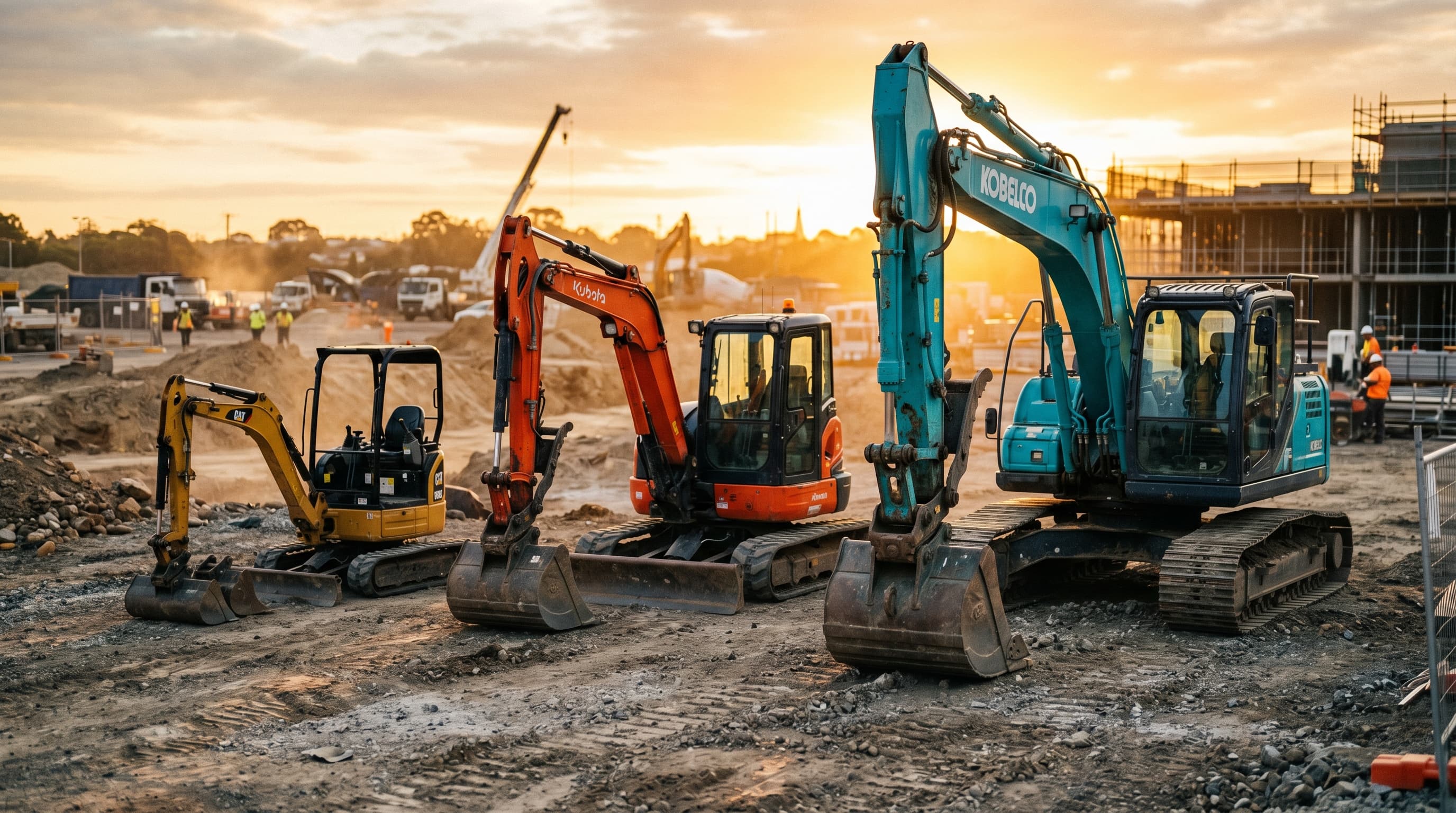
What size excavator do you need? For most residential and light commercial work, the answer is a 3-8 ton mini excavator. For basements, commercial utilities, and 3-5 acre sites, step up to a 13-18 ton midi. For subdivision site prep and anything above 10 acres, a 20-30 ton full-size standard is the production workhorse. The specific model depends on dig depth, access, and how many yards of dirt you plan to move per hour.
Size matters more than brand. A $58,000 Cat 305.5 is the wrong tool for a commercial basement, and a $220,000 Cat 323 is absurd for a backyard French drain. Over-buying wastes capital and tears up the job site. Under-buying stretches a two-day job into a week.
This guide breaks excavators into seven size classes from 1-ton micro units to 45+ ton production machines, with a job-by-job matrix, an acreage-based sizing chart, and real model examples at each tier. Pricing context is in our used excavator prices guide and the compact class deep-dive in our mini excavator pricing guide.
TL;DR — Quick Sizing
- Under 1 acre / residential: 1-5 ton mini (Kubota U17, CAT 304, Bobcat E42)
- Pool / small foundation: 3-5 ton small mini
- Residential basement: 13-18 ton midi (Cat 315, Komatsu PC138)
- Commercial utilities: 15-20 ton midi
- 5-15 acre site prep: 20-30 ton full-size (Cat 323, Komatsu PC210)
- Mining / quarry / 15+ acres: 30-45+ ton full-size large or production
Excavator Size Classes Explained
Excavator manufacturers segment the market into three broad families — mini, midi, and full-size — and those families break down into seven practical size classes. The divisions come from operating weight, which directly drives dig depth, breakout force, and bucket capacity.
Operating weight is the single most useful sizing metric because it correlates with almost every other spec. A 5-ton machine will dig roughly 10 feet deep, a 15-ton machine will dig 15-16 feet, and a 30-ton machine will dig 22-24 feet. Dig depth scales predictably with weight.
Excavator Size Chart by Operating Weight
The Full Excavator Size Chart
| Class | Weight | Dig Depth | Breakout | Best For | Example Models |
|---|---|---|---|---|---|
| Micro / Compact Mini | 1-2 ton | 5-8 ft | 1,500-2,800 lbs | Landscaping, trenching, backyard work, tight-access jobs | Kubota U17, Bobcat E20, CAT 301.7 |
| Small Mini | 3-5 ton | 9-11 ft | 4,800-8,200 lbs | Residential foundations, pools, utility trenching, fence lines | Kubota KX040, Bobcat E42, CAT 304, Deere 50G |
| Large Mini | 5-8 ton | 11-13 ft | 8,500-13,000 lbs | Light commercial, deeper utilities, small basements | CAT 305.5, Kubota KX057, Deere 60G, Kubota KX080 |
| Midi | 10-18 ton | 14-18 ft | 13,000-23,000 lbs | Basements, site prep, commercial utilities, small demolition | Cat 315, Komatsu PC138, Deere 135G, Kubota KX080 |
| Full-Size Standard | 20-30 ton | 20-24 ft | 25,000-40,000 lbs | Subdivisions, commercial foundations, mass excavation, road work | Cat 323, Komatsu PC210, Deere 210G, Hitachi ZX210 |
| Full-Size Large | 30-45 ton | 24-28 ft | 40,000-55,000 lbs | Quarry, mining, large site prep, heavy demolition | Cat 336, Komatsu PC360, Deere 350G, Volvo EC380E |
| Production / Heavy | 45+ ton | 28+ ft | 55,000+ lbs | Mining, quarry, major civil projects, scrap handling | Cat 395, Komatsu PC490, Deere 470G, Hitachi ZX470 |
Source: OEM spec sheets from Caterpillar, Kubota, John Deere, and Komatsu, 2025-2026 model year data.
Max Dig Depth by Class
Mini vs Midi Excavator: What's the Real Difference?
The mini-versus-midi question is the most common sizing decision contractors face because these two classes overlap in price and capability. Mini excavators top out around 10 tons and 13 feet of dig depth. Midi excavators start at 10 tons and dig 14-18 feet. The overlap sits right where basements, utility trenching, and small commercial sites live.
A mini is the right call when any of these are true:
- You need to transport on a standard bumper-pull or gooseneck trailer (under 20,000 lbs GVWR combined)
- Your work stays under 12 feet of dig depth
- Access is tight — gates, backyards, existing structures, finished surfaces
- You bill on residential projects where a 25-ton machine is overkill for the property size
- You run solo and need a machine one operator can trailer, fuel, and maintain
A midi becomes the right call when any of these are true:
- You regularly dig deeper than 12 feet (basements, deep utilities, storm drains)
- You need hydraulic flow for large breakers, grapples, or mulchers over 45 GPM
- You're moving real volume — commercial site prep, small demolition, pond work
- You have consistent 800+ hour years that justify a $120,000-$250,000 purchase
- You operate on commercial sites where a tag trailer and CDL are already in the mix
A landscape crew out of Austin runs two Kubota KX057s (5.7 ton, $45K each) instead of a single Cat 315 (15 ton, $165K) because they can split crews across two job sites, trailer anywhere without permits, and still handle every job they bid. That's the right call for their business model. A commercial utility contractor doing sewer mains every week needs the midi — a mini can't trench 14 feet deep reliably.
Pro Tip
When you're on the line between mini and midi, bias toward the smaller machine and supplement with rental days for the 2-3 deep jobs per year. Owning a $165K midi for 200 hours of annual deep work is worse economics than owning a $50K mini and paying $1,800/day for a midi rental 6-10 days per year. Our rent-vs-buy breakdown runs the full math.
Excavator Size Chart by Job Type
The fastest way to size an excavator is to start from the job, not the machine. Here's the job-to-size matrix we use when helping buyers match a machine to their actual work. Read it as guidance, not gospel — site conditions (soil type, access, timeline) shift the recommendation by a class in either direction.
| Job Type | Recommended Size | Why |
|---|---|---|
| Residential landscaping (1/4 acre) | Micro (1-2 ton) | Fits through gates, minimal turf damage |
| Backyard pool (16x32 ft) | Small Mini (3-5 ton) | 8 ft dig depth, manageable spoil pile |
| Foundation for 2,000 sqft home | Small to Large Mini (4-7 ton) | 10-12 ft dig, efficient spoil handling |
| Fence line or french drain | Micro or Small Mini (2-4 ton) | Narrow bucket work, long runs |
| Sewer/water lateral (residential) | Small Mini (4-5 ton) | 8-10 ft dig, side-to-side trenching |
| Residential basement | Midi (13-18 ton) | Dig depth + breakout force + spoil throw |
| Commercial utility mains | Midi (15-20 ton) | 15+ ft dig, sustained production |
| 5-10 acre site prep | Standard Full-Size (20-25 ton) | Production rate across large area |
| Pond or small lake (1-2 acres) | Standard to Large Full-Size (25-35 ton) | Bulk spoil movement |
| Demolition (residential) | Midi to Full-Size (18-25 ton) | Reach + hydraulic breaker flow |
| Tree/stump clearing (wooded acre) | Small Mini to Midi (5-15 ton) | Grapple attachment capacity |
| Road and highway construction | Full-Size (25-35 ton) | Continuous production, trailer-friendly |
Job-to-Size Fit Matrix
A few patterns fall out of the matrix. Most residential work fits in the 3-8 ton range. Midis dominate the commercial utility and basement segments. Full-size machines earn their keep on jobs where cycle time beats access — subdivisions, road work, and anything measured in acres rather than square feet.
Excavator Size by Acreage
Acreage is a rough proxy for production needs. A larger property usually means longer runs, more spoil volume, and more reason to pay for cycle time with a bigger bucket. But the relationship isn't linear — a 10-acre wooded lot being cleared needs a different machine than a 10-acre flat field being graded.
Recommended Excavator Size by Project Acreage
| Acreage | Recommended Class | Reasoning |
|---|---|---|
| Under 1 acre | Micro or Small Mini (1-5 ton) | Access matters more than production. Narrow gates, protected turf, short runs. |
| 1-3 acres | Small to Large Mini (3-8 ton) | Versatile for mixed residential and light commercial work. |
| 3-5 acres | Large Mini to Small Midi (7-15 ton) | Production starts to outweigh access. Longer trenching runs and larger spoil piles. |
| 5-15 acres | Midi to Standard Full-Size (15-25 ton) | Mass excavation, utility mains, and site prep require sustained production. |
| 15+ acres | Full-Size (25-45 ton) | Commercial and industrial scale. Bucket capacity and cycle time dominate cost-per-yard. |
A small-farm owner in Missouri asked us recently which machine to buy for maintaining 8 acres of pasture, pond banks, and a gravel driveway. The answer: a 5-6 ton mini like the Kubota KX057 or CAT 305.5. Acreage suggested a midi, but the jobs — cleaning ditches, digging fence post holes, maintaining the pond overflow — all fit the compact range. Job type beats acreage when they conflict.
Sizing by Dig Depth
Dig depth is the hard constraint that invalidates a size choice faster than anything else. If the job calls for 14 feet and your machine maxes at 11, no amount of operator skill fixes that. Always size to your deepest expected dig plus 1-2 feet of margin.
- 0-8 feet: Micro class (1-2 ton) handles it. Perfect for landscape grading, shallow drainage, fence post foundations.
- 8-11 feet: Small mini class (3-5 ton). The residential utility and pool range.
- 11-13 feet: Large mini class (5-8 ton). Deeper utilities, crawlspace foundations, small basements.
- 13-18 feet: Midi class (10-18 ton). Full basements, commercial utility mains, storm drainage.
- 18-24 feet: Standard full-size (20-30 ton). Deep commercial work, mass excavation, quarry.
- 24+ feet: Large full-size or production class (30-45+ ton). Mining, deep civil, long-reach applications.
Also consider reach. Dig depth tells you how deep, but reach tells you how far the boom can work from the pivot. A full-size machine's 30-foot reach lets the operator dig a basement perimeter without repositioning — a mini needs 5-8 setups to do the same job.
Other Sizing Considerations Beyond Weight
Operating weight is the headline number, but a handful of secondary specs should shift your size choice. Pay attention to these before signing anything.
Tail Swing vs Reduced Tail Swing
Conventional excavators swing their counterweight outside the track width. Reduced tail swing (RTS) and zero tail swing (ZTS) machines tuck the counterweight inside the tracks, letting the operator work right up against walls, fences, and other obstacles. ZTS minis cost 10-15% more but save major time on urban and residential jobs. For tight-access work, always spec ZTS or RTS.
Transport and Trailering
A machine you can't haul is a machine you don't own. Gooseneck trailers rated at 20,000-26,000 lbs GVWR handle most minis comfortably. Step up to a deckover or tag trailer with 30,000+ lb capacity for large minis and small midis. Full-size machines require a Class 8 truck, lowboy trailer, and often a commercial driver's license. Transport cost per mile scales with trailer class. Our shipping costs guide breaks down the per-mile rates by machine size.
Hydraulic Flow for Attachments
If attachments are core to your work, match the hydraulic flow to the biggest attachment you plan to run. Hydraulic breakers, thumbs, mulchers, and grapples all pull real flow — often 20-55 GPM depending on size. Most minis deliver 13-25 GPM. Midis run 30-55 GPM. Full-size machines push 55+ GPM. Undersized flow means slow attachment performance or outright incompatibility. The attachments guide covers flow requirements by attachment type.
Operator Comfort and Cab Size
A bigger machine has a bigger cab, better HVAC, and more legroom. If your operators spend 40+ hours per week in the seat, cab size matters. Minis under 4 tons often have cramped cabs with limited air conditioning. Midis and full-size machines offer full climate control, adjustable seats, and visibility packages that reduce fatigue. Productivity drops when operators are uncomfortable.
What Each Size Class Costs (New and Used)
Price follows weight closely. Here's the typical 2026 range by class, based on auction results from Ritchie Bros and residual values from Equipment Watch.
| Class | New MSRP | Used (2-4K hrs) | Daily Rental |
|---|---|---|---|
| Micro (1-2 ton) | $28K-$55K | $11K-$25K | $220-$320 |
| Small Mini (3-5 ton) | $55K-$95K | $24K-$55K | $320-$450 |
| Large Mini (5-8 ton) | $85K-$130K | $32K-$68K | $450-$600 |
| Midi (10-18 ton) | $140K-$250K | $65K-$150K | $700-$1,100 |
| Standard Full-Size (20-30 ton) | $220K-$380K | $95K-$220K | $1,200-$1,800 |
| Large Full-Size (30-45 ton) | $380K-$650K | $180K-$400K | $1,800-$2,800 |
Prices reflect 2019-2024 model year used machines in fair to good condition. Sources: Ritchie Bros auction results, IronPlanet listings, Equipment Watch residual values, Q1 2026.
The price jump from large mini to midi is the steepest in the market — roughly doubling for a 2-3x increase in capability. That jump is where most buyers second-guess themselves. If you can do 85% of your work with a $55,000 large mini, renting a midi for the remaining 15% usually wins the math. Our total cost of ownership calculator shows how to model this properly.
Common Excavator Sizing Mistakes
After years of moving machines through the used market, the same sizing mistakes show up on both ends:
- Buying for the biggest job, not the average job. If 90% of your work is 3-5 tons and 10% is 15 tons, buy the small mini and rent the midi. Owning steel you use twice a year is a capital drain.
- Ignoring transport. A 7-ton large mini looks cheap until you realize your trailer maxes at 20,000 lbs GVWR combined and you need a $12,000 trailer upgrade to haul it legally.
- Over-indexing on horsepower. Excavators are hydraulic machines. Horsepower matters less than hydraulic flow, pump capacity, and system pressure.
- Skipping the pre-purchase inspection. Any used machine over $20,000 deserves a professional inspection before purchase. Our used equipment inspection guide walks through the 40-point checklist.
- Ignoring undercarriage wear. A machine with 40% remaining track life is one big job away from a $15,000 undercarriage bill. Check our undercarriage cost guide for what to look for.
- Forgetting hour meter reliability. Low reported hours aren't always real hours. Review our hour meter guide to verify before you buy.
There is one question worth settling before any of the sizing math: does the work justify owning a machine at all? For a single site-prep, trenching, or lot-clearing scope, hiring it out is usually cheaper than buying — the contractor already has the right size machine, the trailer to move it legally, and an operator who runs one daily. In the Sacramento area, NorCal Earthworks does excavation, grading, and land clearing on that basis. Size a purchase around the work you expect to repeat, not the one job sitting in front of you.
Frequently Asked Questions About Excavator Sizing
What size excavator do I need for a 1-acre property?
A 1-acre property almost always sits in the mini excavator range (1-6 ton class). Residential landscaping, pool digs, fence line clearing, small foundation work, and French drain installation all fit comfortably within a 3-5 ton mini like a Kubota KX040, CAT 304, or Bobcat E42. These machines fit through 48-inch gates, won't tear up existing turf, and dig 9-11 feet deep — enough for almost any homeowner or small contractor job. Stepping up to a midi only makes sense if you're removing large trees, boulders, or trenching more than 12 feet deep.
What is the difference between a mini and midi excavator?
Mini excavators weigh under 10 tons (roughly 2,000-20,000 lbs) and are sized for residential, landscape, and tight-access work. Midi excavators weigh 10-20 tons and bridge the gap between compact and full-size machines. The practical difference is dig depth and breakout force — a midi like a Cat 315 or Kubota KX080 digs 15-18 feet with enough hydraulic muscle for utility trenching, larger foundations, and commercial site prep. Minis top out around 11-13 feet of dig depth and can struggle with heavy clay or rocky soil.
What size excavator do I need to dig a basement?
A residential basement dig typically requires a midi excavator in the 13-20 ton class. You need 8-10 feet of dig depth with room to set back the spoil pile, and enough breakout force to handle compacted soil and small boulders. A Cat 315, Komatsu PC138, or John Deere 135G handles standard residential basements in 1-2 days. Larger custom homes with deeper walk-out basements or tight urban lots may require a 20-25 ton full-size excavator for efficiency, while a cramped suburban lot with limited swing radius may favor a reduced-tail-swing midi.
Can a mini excavator dig a pool?
Yes, a mini excavator can dig most residential pools, but size matters. A standard 16x32 inground pool requires 6-8 feet of dig depth and roughly 40-60 cubic yards of spoil removal. A 5-6 ton mini like the Kubota KX057 or CAT 305.5 handles this comfortably in 1-2 days. For smaller spool or plunge pools under 200 square feet, a 3-4 ton mini works fine. For larger pools exceeding 500 square feet or pools with deep ends beyond 8 feet, a midi excavator speeds the job and reduces operator fatigue significantly.
How many acres can a full-size excavator handle?
Full-size excavators in the 20-45 ton class are built for production work on 5+ acre sites and unlimited on commercial projects. A Cat 336 or Komatsu PC360 can clear, rough-grade, and excavate utilities across a 10-acre subdivision site in a few weeks. The practical ceiling isn't acreage — it's job type. Full-size machines move too much material, damage finished surfaces, and require specialized trailer permits that make them impractical for small residential work regardless of acreage.
Should I buy an excavator or hire a contractor?
Hire it out for a single project; buy when the work repeats. One-off site prep, a trenching run, or a lot clearing rarely justifies purchase price plus trailer, insurance, maintenance, and storage — and a contractor arrives with the correctly sized machine and an operator who runs one daily. Ownership starts to pay when the machine is billable across multiple jobs a year, or when mobilization delays cost you more than the carrying cost. Size a purchase around the work you expect to repeat, not the job in front of you. In the Sacramento region, NorCal Earthworks does excavation, grading, and land clearing on a hired basis.
What is the best excavator for utility work?
For standard utility trenching — water lines, sewer laterals, electrical conduits — a 5-8 ton mini or small midi excavator is ideal. Machines like the Kubota KX080, Cat 308, or Deere 85G offer 12-14 feet of dig depth and enough cab room for all-day operator comfort. For deeper municipal water mains, gas lines, or storm drainage at 15+ feet, step up to a 15-20 ton midi like a Cat 315 or Komatsu PC138. Our compact excavator pricing guide covers the full mini and midi range in detail.
Find the Right-Sized Excavator
Sizing an excavator is a trade-off between dig depth, access, production, and total cost of ownership. Start with the job type and the deepest dig you actually need, then confirm the machine fits your transport setup and attachment plans. Most contractors end up in the 3-8 ton mini range; serious commercial work moves up to midi; site developers and civil contractors need full-size.
If you're buying, browse our excavator inventory by class to compare specs side by side. If you're selling, we provide cash offers within 24 hours based on live market data — no listing fees or auction waits.